Naujamiestis (New Town) Borough in Vilnius
New Town is a product of 19th-century expansion, which was minor in Vilnius compared to major metropolises of Western Europe but nevertheless increased the Vilnius population fourfold (from 50 000 in 1800 to over 210 000 in 1914).
Naujamiestis was conceived by the Russian Empire to be the grand center of what was then the capital of its Vilnius Governorate and the main city in the Northwestern Krai (an administrative unit roughly comprising modern-day Lithuania and Belarus). Naujamiestis lies entirely to the west of the Old Town.
Gedimino Avenue
2 kilometres long, Gedimino Avenue (laid in the 19th century) is still widely regarded as the main street of Vilnius. It leads from the Cathedral Square to Žvėrynas borough, passing by many stately buildings. Most of Lithuania's ministries, its government, and parliament, as well as its National Theatre, and three major courts of law, are located along this thoroughfare. Unfortunately, Gedimino Avenue is relatively narrow for its importance. Therefore, some of its architectural details might be hard to notice without looking upwards. Interesting buildings include (from east to west) the Science Academy building, Saint George Hotel (currently restored as an apartment building), Statistics Department building, Court of Appeals building, Traders' Club building. The Bank of Lithuania also has a modern Money museum with Guinness-inscribed coin pyramid. Numerous restaurants and shops are primarily concentrated at the Cathedral side of the Avenue.

Gedimino Avenue near V. Kudirkos Square during the Day of Street Music. Many events are organized on the Avenue, and at these times it is pedestrianized. ©Augustinas Žemaitis.
To the east of the Saint George Hotel, there is Vinco Kudirkos square (one-third way from the Cathedral to Žvėrynas) that boasts a statue to V. Kudirka (the author of the Lithuanian anthem). It is surrounded by monumental buildings of every post-1880s style that was popular in Lithuania. To the north stands the Soviet functionalist Government of Lithuania (1982), east is dominated by the imposing historicist Gedimino 9 shopping mall (former municipal palace, 1893), west is covered by a Stalinist apartment building (1950s), whereas the southern flank of the square has interwar buildings (1930s) and a Novotel hotel (2000s).
The Courts building (1890) at large Lukiškių square (about two-thirds of the way from Cathedral Square to Žvėrynas) used to serve as HQ for both the Gestapo and KGB. Many people were tortured and murdered here; some of their names are now inscribed on the 19th-century building, which now also houses an interesting Museum of Occupation and Resistance, also known as the Museum of Occupations and Freedom Fights (where you can visit authentic KGB cells). Once, a Lenin statue stood in the center of Lukiškių Square, and now this place is empty, but on the flanks of the square there are memorials for Lithuanian partisans and those exiled to Siberia by the Soviet regime. The particular Exiles monument was planned to be erected in Yakutsk, Russia, but this was banned by the Russian government even though it was accepted by Yakutsk authorities.

The courts building in Gedimino Avenue and Lukiškų Square. Part of the building is dedicated to the Museum of the Occupation and Resistance. ©Augustinas Žemaitis.
Lukiškių Square is surrounded by other interesting buildings such as the Church of Saints Phillip and Jacob (predating Naujamiestis, 1727) and a complex of terrace homes developed by banker Juozapas Montvila in 1911-1913; every part of the building is of a different architectural style. One of the church towers hosts a carillon that offers free plays every day at ~13:00 as well as before Mass. Not far away is the 19th-century Lukiškės prison, the nation's main penitentiary for over a century, now serving as an art space.
The Lithuanian parliament building on the western end of Gedimino Avenue is modern (built in 1982, expanded in the 2000s). However, its historical importance far outweighs its size or beauty, as it is the spot where the Soviet Union started to collapse when Lithuania became the first country to declare independence on March 11th, 1990. On January 1991 Soviet forces attacked Vilnius, but a great mass of people surrounded parliament and built concrete barricades (a couple of them remains as a monument on the Neris side of parliament still boasting the original graffiti). The Soviets did not capture the square, now named after independence (Nepriklausomybės). Laid over a major automobile tunnel, this square also houses the National Library and is overlooked by somewhat vacant office towers.
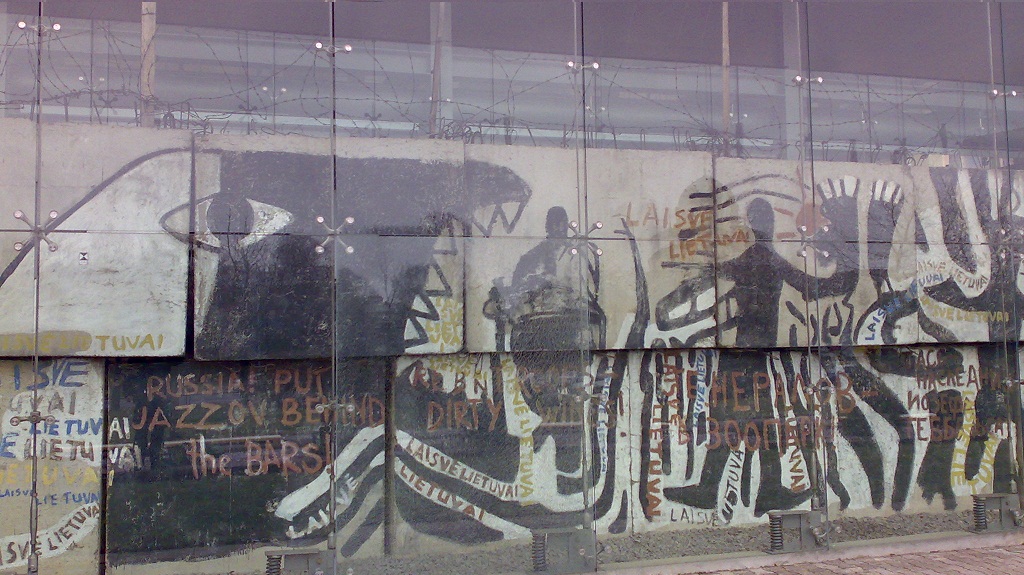
An example of the concrete barricades used during the siege of Vilnius in January 1991. Graffiti tells a story of Lithuania's political climate of the time. Much of it is in English, as the Lithuanians hoped to receive help from the West in their plight. ©Augustinas Žemaitis.
Bank of Neris
The southern bank of Neris at Žygimantų street (just to the west of the Cathedral Square) looks gracefully from the other side of the river. Buildings here are mostly early 20th-century apartment blocks, and during this era, the street was a popular boulevard for leisure walks.
Naujamiestis remained the most important city borough up to the 1990s. Therefore, it has a fair share of interwar and Soviet monumental buildings. The best place to watch for Stalinist architecture is the banks of the Neris River further downstream (Goštauto Street), where the House of Scientists stands crowned by a tower (1951). Here scientists used to live under Soviet rule (some of them still do). Not far away to the east is the building dedicated to "returnees" - emigrant Lithuanians who chose to return to Soviet Lithuania after Stalin's invitation in the late 1940s. These returnees were important for propaganda, but with the exception of apartments in this building, Stalin gave them little else, breaking his promises.

House of the Scientists by architect Giovanni Rippa from Leningrad on Goštauto Street is one of the best examples of the monumental Stalinist architecture in Lithuania. ©Augustinas Žemaitis.
Between the Stalinist and the pre-War Neris banks stands a late-Soviet National Opera and Ballet theater (1974) with its kitsch interior decor. It is a good opportunity to see world-class opera and ballet performances at lower-than-in-the-West prices.
In front of the National Opera Theatre, you will see the Žaliasis (Green) Bridge that leads to Šnipiškės borough. While a bridge over the Neris River stood at this place for centuries, the current one dates to the Stalinist era (1952). It used to have the final Soviet statues in Vilnius on top, but they were demolished in 2015.
Tauras Hill area
Another nice 19th-century street is the uphill Basanavičiaus Street where the palatial HQ of Lithuanian railways (constructed in 1903 as HQ for railways of the western Russian Empire) proudly stands. On the other side of the street is the Old Theatre. This building used to be a Polish theater before the Soviet occupation; it was converted to a Russian Theatre by the Soviets and still offers plays in Russian. It was built in 1913 following an architectural style reminiscent of southern Poland (Zakopane style).

Basanavičiaus-Mindaugo intersection. Railways HQ building is in the center. When built, this 8-story building was the highest secular structure in the city. ©Augustinas Žemaitis.
Kalinausko street offers an alternative ascension route from the Old Town. It passes the Frank Zappa statue unveiled by local fans amidst US media attention in 1995 (since 2010, its copy stands in Baltimore). It is not only a monument to the singer but also to the libertarian Lithuania of the 1990s, when seemingly anything was possible with no bureaucracy to preclude it.
On the top of Tauras hill a Lutheran cemetery used to be, but it was demolished by the Soviets. The hill gives nice views of the city.
The northern slope of Tauras hill is an open area. This allows great views towards Gedimino Avenue, Neris river, and New City Center. If you go downhill by stairs from here you will reach Pamėnkalnio street. Running parallel to the Gedimino Avenue Pamėnkalnio street also has some nice buildings from the 19th century and the Stalinist era Pergalė cinema (now a major casino). Pamėnkalnis, by the way, is the historical name for Tauras hill, possibly relating to ghosts.
On top of the Tauras hill a calm M. K. Čiurlionio street passes by turn-of-the-century urban villas, Vilnius university faculties, and new expensive developments. It leads to Vingis (Bend of Neris) park, a popular place for summer strolls and an unlikely location of the Lithuania's main rugby stadium in addition to the German soldier cemetery and the central lawn where the pro-independence demonstrations of the late 1980s have now been replaced by the gigs of foreign divas.
Station district
Both railroad station and bus station of Vilnius are located in the southernmost end of Naujamiestis. Together with the surrounding plaza, they were built under Soviet occupation (after destroying many older buildings). But the adjoining streets like Šopeno are still full of stately buildings dating to the dawn of the 20th century and are worth exploring. Additionally many cheap hostels and various restaurants are located within easy reach from the stations. This particular area known as „Stoties rajonas“ („Station district“) has a bad reputation for prostitution and criminal activity but it has been undergoing a rapid gentrification and "hipsterization" in the 2010s, offering numerous popular bars.

Map of Naujamiestis. ©Augustinas Žemaitis.
Click [+] for more
Sister websites
- Destination Lithuanian America Lithuanian-American heritage sites map
- Global True Lithuania Lithuanian communities and heritage all over the world
- On Latvia All about Latvia
- True Lithuania Youtube English videos on Lithuania and interviews with Lithuanians abroad


October 16th, 2016 - 18:36
hello,
Thank you for this informative website. You have included so much history but also recent information.