Heritage search services and Facebook account
Given a large interest from people of Lithuanian origin, True Lithuania website begins offering investigative services on your heritage in Lithuania.
We help locate relatives and information on family history. We search for and read Lithuanian language sources, if necessary check the state and church archives and provide legal services in Lithuania. If interested, contact us by e-mail (tourbaltic@gmail.com).
P.S. 1,5 years after its launch True Lithuania website acquired its Facebook account. We invite you to Like/Follow us.
Lithuania wins silver at Eurobasket 2013
2013 09 22. Lithuania celebrates as its national basketball team won a silver medal in European Basketball Championships. While they were defeated by France (66-80) in the gold medal game this is still a great achievement for a 3 million-strong nation.
While Lithuanians are regular guests at every major basketball tournament the last time they played in Eurobasket final game was 10 years ago (2003) when they achieved gold. Decennial of the event has been recently commemorated by a festival game where the golden Lithuanian team of 2003 (most of them already past their careers) faced foreign European players of the era.
Unlike in 2003 the street joy will probably not last multiple days this year. But in Vilnius downtown, a foreigner could not easily tell that Lithuanians lost the final game. Hundreds of fans are shouting, honking, waving flags, greeting each other and celebrating despite the rain. Tomorrow the Rotušės square will likely be full for a national team welcome back ceremony.

Costumed Lithuanian fans stopped their cars and waving flags in streets after the silver medal is won. ©Augustinas Žemaitis.
As usual, basketball victories are the main power to unite Lithuania and make it shed its introverted appearance. They are also the nation's prime ambassador abroad, making the name "Lithuania" well known in every nation where the world's 2nd team sport is popular.
On their route to silver Lithuanians defeated Macedonia, Latvia, Montenegro, France, Belgium, Ukraine and Italy and lost to Serbia, Bosnia an France. Power forward Linas Kleiza made it to the symbolic top 5 of the championship. The second place in Eurobasket also guarantees participation in the FIBA World Cup 2014 in Spain so Lithuanians will not be left without international basketball as their beloved team will try to repeat or improve their achievements of 2010 when it turned out third.

Lithuanian fans greet power forward Darjuš Lavrinovič in a welcome back ceremony on 23rd September 2013. ©Augustinas Žemaitis.
Lithuania in the European Union: Presidency and challenges
September 1st, 2013 marks two months after Lithuania started its presidency of the Council of European Union. While advertised as an important achievement by the government to the Lithuanians it is more of a routine procedure. In the European Union, all the member countries rotate in assuming this 6-month presidency.
The Council of the European Union which consists of minister delegates from every member state. The meaning of its presidency, however, has been reduced over the time. The council now convenes in Belgium regardless of which country presides with only some minor events taking place in the presiding nation. After the 2009 Treaty of Lisbon was passed the presiding country has been stripped of much of its powers, having been replaced by permanent EU officials.

Lithuania's presidents residence outfitted in EU-themed lighting for the six months of Lithuanian presidency over the European Union. ©Augustinas Žemaitis.
Stances towards the European Union in Lithuania
More than 9 years have passed since Lithuania joined the European Union in 2004 so it is now possible to evaluate Lithuanian EU relations, the local stances towards EU and their reasons. Just like in 2004 all the main parties (Homeland Union, Socialdemocrats, Liberals) support EU membership. They tend to swiftly adopt various EU measures. When the European Constitution was proposed in 2004 Lithuanian parliament raced to become the first country to ratify it - without any public discussion or evaluation. Despite this zeal the Constitution was later voted against by the French and Dutch people in referenda.
In Lithuania, however, a referendum on an EU issue would be unimaginable as the establishment would not want a negative answer. The only referendum that took place was for the EU membership itself (as it was required by the Constitution). To ensure a positive result the referendum law has been amended (the lower requirements for number of votes were effectively applicable to that single referendum alone) and the voters were provided free goods in return to voting. What would have been heavily controversial had the referendum been on any other issue passed largely unnoticed by both local and foreign democracy activists as most of them supported the EU enlargement.
Some Lithuanian EU critics even claim this reminds of Soviet occupation when communist functionaries were willing to appease Moscow disregarding the wishes of the local population. Most locals, however, have little understanding of what the Union could and could not do and don't care that much about it. Proceedings of European institutions are largely ignored by media and European parliament elections have a pitiful turnout (~20%). This made Brussels a popular "political refuge" for controversial high-ranking politicians and a good place to develop popularity. After serving a term in some European institution their popularity surge due to perceived importance of their jobs and no public scandals. Dalia Grybauskaitė is the greatest success story: largely unknown before her tenure as a European finance commissioner she was elected Lithuanian president with 68% votes immediately afterwards (in 2009).
Still, the Euroskeptic voices are few and far between and even held "politically incorrect" by much of the establishment (with even Lithuanian foreign minister Linas Linkevičius claiming that politicians who put national interests ahead of EU interests are a problem). The eurosceptics include some signatories of Lithuanian independence declaration and other intellectuals who currently lack any political power or much media attention. Far left "Frontas" party is also Euroskeptic; its pro-Soviet stance made it easy for pro-EU establishment to portray the entire Euroskeptic population as radicals (e.g. xenophobic) or even a "Russian fifth column". The pro-Russian euroskepticism is, however, the smaller one of the several types present. The other one advocates bringing more decisions back home to Lithuania and increasing its sovereignty, at least on political and cultural matters.
The European Union is not a defensive alliance yet some of its supporters believe that the membership may prevent a Russian invasion (as other member-states would be less likely to tolerate an occupation of Lithuania when it is a member-state). As Lithuania has been occupied by Russian states for 166 years out of the recent 220 years, some still see a new Russian occupation as the biggest threat.
European Union influence on Lithuanian economy
With their economy ransacked by a 45-year long Soviet occupation Lithuanians now receive more money through European Union budget than Lithuania pays into it, meaning the membership is profitable on a short term. The exact profitability is hard to measure impartially as some of the EU support goes directly to fund the local EU measures, such as the expensive EU-ordered closure of Ignalina Nuclear Power Plant near Visaginas, while some of the EU-imposed Lithuanian payments go directly to EU programs rather than EU budget (e.g. the European Development Fund).
The Lithuanian economy now grows, as it did both before an after EU membership save for the economic downturn years, so it is expected that eventually, Lithuania would become an overall contributor to the EU budget.
Who receives the EU money is however frequently criticized by both EU supporters and detractors as many projects suffer from embezzlement. The usual scheme is simple: unfaithful developers of EU-sponsored projects pay artificially inflated prices for various project-related services; a large part of this money is then secretly returned by the service provider (part of it may be used to bribe the state officials to turn a blind eye). While "professional EU applicants" get large-scale funding through the aforementioned schemes, ordinary businessmen lack the experience to successfully pass the application bureaucracy. Such situation leads EU critics to claim that the political establishment is pro-EU precisely because EU gives them access to large amounts of "free money".
Furthermore, the Lithuanian farmers claim discrimination as they are paid only 28% of what Greek farmers are paid for the same land area and 52% of EU average, yet they must be competitive in the same market as the EU had abolished duties. This is not a small deal as agriculture funding makes up 41% of total EU expenditures. Then again this does not make the farmers eurosceptic as prior to the EU membership most were even less well off.
The most profound EU influence, however, has been the rapid emigration. Any EU member-state citizen may freely settle and work in another member-state. Before 2004 expansion all EU members had relatively similar developed economies this posed little problems. But for an Eastern European a job in the West may provide salary several times those at home. Some 12% Lithuania's people, most of them young and many of them skilled, left for good in the recent decade - leaving their homeland stretched infrastructure and aging population as well as putting further growth at stake.
Are European cultures equal in the Union?
In addition to using objective economic criteria, the European Union increasingly influences local culture and political opinions by sponsoring local organizations that support various EU agendas (e.g. the scientifically disproven theory that men and women have no inborn psychological differences).

House of Europe in Vilnius (opened in 2013) operates in the first floors of the building. It includes the European Institute of Gender Equality, the sole central EU institution moved into Lithuania. However, recently top EU politicians deliberated whether such separate institute is needed at all. ©Augustinas Žemaitis.
Another key EU agenda is promoting the European identity over either global, national or regional ones. Proponents (among them a disproportional number of Western European elite) see this as a measure to avoid wars; detractors point that the previous regional unification attempts (e.g. Germany in the 19th century) only replaced internal wars by external ones. Some showcase "European identity" measures (e.g. a single-design car licence plates) make the Union member-states even less independent in particular spheres than the USA states.
All of the above are heavily controversial and lead to a belief that the European Union is about transplanting ideas and values from the Western core to the newly-joined East rather than about exchanging ideas and respecting values of each other.
Lack of respect for Lithuanian and other Eastern European victims of the Soviet genocides is another controversial issue. Looking through a Western European prism World War 2 was fought between totalitarian Germany vs. democratic nations. In the Eastern Europe, however, everything was different with not one but two totalitarian powers (the Soviet Union and Nazi Germany) occupying weaker states and committing genocides. Soviets murdered several times the number of people Nazis did. Much of their actions were ethnically-based and some ethnicities (e.g. Kalmyks) had 50%+ people killed and their culture largely destroyed (through expulsion to GULAGs/Siberia of the entire population where most died). 7 million Ukrainians murdered in Holodomor mean that there were more Ukrainian victims of the Soviet genocide alone than Jews murdered by Nazis. While total expulsion of Lithuanians was not done (although deliberated), Lithuania still lost over 30% population under the Soviet rule. Therefore it is painful for Lithuanians and many other non-Russian Eastern Europeans to hear some European Union officials not regarding their murderers the same way as the murderers who also ravaged the West (i.e. the Nazis).
When will Lithuania adopt the Euro?
The next major EU-related issue for Lithuania is the adoption of Euro as its currency. Prime minister Algirdas Butkevičius claimed there is no place for discussion nor referendum as Euro was already accepted by the 2004 referendum (it was not directly mentioned in the referendum question though). However with the recent Euro-related economic downturn in Greece and Portugal public opinions on Euro are more negative than ever (55% oppose it). Unlike much of the EU work which falls outside the scope of interest of an average Lithuanian, the currency change will influence everybody. In response to the unfavorable public opinion A. Butkevičius claimed that "an informational campaign will be necessary", likely meaning a large state-funded PR campaign to make the nation more pro-Euro. Until now such campaigns have been successful (including the one before EU membership referendum), but the introduction of Euro may be the toughest issue the pro-EU establishment faced to date. The government hopes to introduce Euro by 2015.

The design for Lithuanian Euro coins has been already prepared in 2007 and will feature Vytis. All Euro banknotes are the same regardless of country (on the contrary to British pounds which have separate versions for England and Scotland).
Palace of the Grand Dukes opened in Vilnius
On July 7th, 2013 the Palace of the Grand Dukes (Valdovų rūmai) has been opened to the general public in Vilnius Old Town. This is the reconstruction of the original Renaissance palace of 1520 which stood at the same location near Vilnius Cathedral and housed the Grand Dukes of Lithuania. The original palace has been damaged by the Russian invasion in 1655 and completely torn down in 1801 under the Russian Imperial occupation.
Rebuilt palace is now a museum. Ruined basements are authentic while the newly-built interiors are supposed to represent different eras. However, the only difference between the rooms is ceilings and furnaces with all the walls plain white. Exhibits are a mixed stock of mostly authentic archeological finds and mostly replica furniture. Plaques provide Lithuanian and English history of the Grand Duchy.

Palace of the Grand Dukes with Grand Duke Gediminas statue nearby. ©Augustinas Žemaitis.
The Palace project has been highly controversial and suffered time and cost overruns. The construction, first envisioned in 1988, started in 2002 and was planned to be completed by 2009 when the nation celebrated a millennium since the word "Lithuania" has been mentioned for the first time in a surviving written record.
However even today the Palace is only partly completed as a second wing will have to be built for additional 75 million Litas. The true costs of the construction have been higher 3,6 times than planned at first, leading to fruitless criminal investigations.
Other points of criticism for the Palace have been its doubtful authenticity, lack of unified vision for its purpose and the fact that a 19th-century merchant's house had to be demolished to free the construction site.

The Baroque throne room has a replica throne and an authentic chest of drawers (right), but its plain walls are far from baroque opulence. ©Augustinas Žemaitis.
For its proponents, the rebuilt Palace is a potent symbol of the reborn nation, a monument to Lithuanian unity and culture. Under this premise, the project attracted donations from Lithuanian Americans and various companies. Still however it was the taxpayer who covered most of the bill and the true patriarch of the project was late Algirdas Brazauskas, a former communist party member who turned Socialdemocrat post-independence; his quotation now proudly hangs at the entrance and his hunting trophies will be exhibited inside.
For its detractors, the Palace continues to be a white elephant and a symbol of Soviet-style embezzlement, cronyism, and pompousness.
Results of 2011 Lithuanian Census Published
Lithuanian department of statistics published the main results of the decennial census of 2011.
The census highlighted the truly epic scale of Lithuanian emigration. In 2001-2011 decade Lithuania lost 12% of its population (440 600 people). Some three-quarters of this number (9%) left the country (mainly for the Western European labour markets, open to Lithuanians since the country joined the European Union). The remaining decrease (3%) is attributed to low birth rates.
Most of the emigrants are of working age therefore further reducing the birth rate and increasing the strain on economy put by old-age pensioners as their share of the population went from 20% to 21%, an all-time high. At the same time, only 16% of the population is aged under 15, down from 21% in 2001. The average age of Lithuanians increased from 37 to 41 years.
Ethnic composition of Lithuania changed slightly. The share of ethnic Lithuanians increased from 84,2% to 85% of those responding. This increase is likely to be party caused by assimilation as some children of non-Lithuanian parents declare Lithuanian ethnicity. Disproportionately large emigration of some minorities is another reason.
The share of most larger minorities declined with the populations of Soviet era minorities suffering the heaviest setbacks, likely due to emigration to titular homelands (share of Russians went from 6,4% to 5,9%, Ukrainians 0,7% to 0,5%, Belarusians 1,24% to 1,2%). The traditional (i.e. pre-1940) minorities decreased less (Poles from 6,8% to 6,7% and the share of Karaims even increased).
Small minorities saw the largest increase (from 0,1% to 0,15%). They largely consist of new immigrant communities with no pre-1990 populations, e.g. Turks and Chinese. It is likely that their true numbers are even larger due to illegal migration. 154 ethnicities are represented in Lithuania in total (up from 115 in 2001).
In absolute numbers, all the major ethnic communities contracted (most pre-1940 communities by 11% to 15%, primarily Soviet communities by 15% to 30%; the number of ethnic Lithuanians dropped by 12%).
This is in marked contrast to 1989-2001 period (which included the collapse of the Soviet Union). In that era the population of Lithuania declined by 190 000 (5%) but this drop had been mostly fueled by the 1990-1995 departure of Soviet personnel (Soviet ethnic communities declined by some 30% that decade). The numbers of most pre-1940 communities (Lithuanians, Poles), on the other hand, changed only slightly in the 1989-2001 period. In the 1989-2001 economical migration had been relatively minor and it only surged after Lithuania joined the European Union in 2004. Compared to the 1989-2001 the ethnic composition of Lithuania was relatively stable in 2001-2011.
Religion statistics are harder to discern as the number of those not answering the question increased sharply from 6% to 10% (at the same time the option "irreligious" was chosen by 6% of population instead of the previous 10%). The percentage replying "Roman Catholic" decreased from 79% to 77%, the share of Russian Orthodox and Old Believers decreased less while the Protestants gained influence as did the less popular faiths. The total number of religious groups represented increased from 28 in 2001 to 59.
Migration trends meant a decrease of population by 10% to 20% in most municipalities. One exception is Vilnius which declined only by 3% as its emigrants have been replaced by new internal migrants from smaller cities and towns (most of whom prefer to remain in the capital after getting their university or college degrees there).
A trend of suburbanization continued with the population of municipalities around Vilnius, Kaunas, and Klaipėda actually even increasing by 6%-11%. This goes on as more and more Lithuanians leave their cramped Soviet apartments to build their own houses (their availability was limited in 1940-1990 despite the significance of detached family homes in Lithuanian psyche). Some of these suburbs are considered rural for statistical purposes leading to a slight decrease of the total urban population from 66,9% to 66,7%. Villages and towns far from the main cities suffer depopulation, however.
Learning foreign languages took a sharp curve upwards as various multinational companies started working in Lithuania and incoming tourism increased in the 2001-2011. In 2001 25,6% of the population did not speak any non-native language, in 2011 this number was reduced to mere 16,4%; at the same time, the share of those knowing more than one foreign language increased from 29% to 37%. Spoken nearly universally by those over 30 Russian remains the most popular foreign language. However, less than 50% of those between ages 15 and 19 know it while 80% speak English in this age group, demonstrating a major shift in foreign language learning. English have also been eagerly learned by previous generations for better job opportunities and the total share of its speakers nearly doubled from 16,9% in 2001 to 30,4% in 2011.
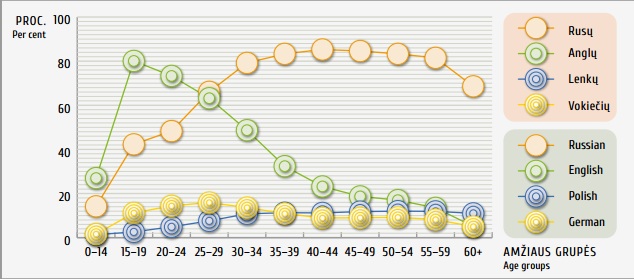
2011 census results on correlation between age and what foreign languages a person can speak. Native languages are excluded (therefore total numbers of Russian and Polish speakers are larger by 6%-8% than shown here). Diagram by Lithuanian department of statistics.
Marriage is becoming less common due to increasing age of marriage, switch to informal cohabitation, increasing divorce rates and aging population (leading to more widows). The number of married people decreased by 17,3% while the number of those divorced increased by 11,9%, never married by 4,1% and widowed by 0,6% (despite a general decrease in population). In 2001 over 50% of the population above the age of 15 was married (60,7% men and 51,6% women). In 2011 these shares decreased to 54,9% men and 45,9% women.
Garliava Story Gives Birth to a Parliamentary Party
On October 15th, 2012 General parliamentary elections took place in Lithuania. Some of the elected party names are likely to be familiar to anybody (Christian Democrats, Labour, Socialdemocrats, Liberals). However, the new "Drąsos Kelias" (Way of Courage) movement also gained seats, receiving 8% of the vote. The party's origins in a single controversial 2009 murder/child custody/paedophilia case may be hard to believe for outsiders.
For 4 years already Lithuania is torn by the unfolding drama now called "The Garliava story", after a suburb of Kaunas. This is a group of intertwined criminal cases with at least 2 people murdered, 2 more people dead in mysterious circumstances. In the opinion of a significant part of Lithuania's population, morality and law stand on the different sides in the Garliava story.
Here is an explanation of that story as one is likely to encounter the issue in Lithuania, in the form of public protests, jokes, and heated debates.
Girl's rape videotestimony shocks Lithuania
It all came to public attention in 2009 August when Drąsius Kedys, a father of then 5-year-old girl, provided every major media company with a copy of a video recording where his own daughter tells how she was molested and raped by paedophiles. Media reported this but refused to air the complete recording due to children rights protection. Instead, they interviewed Drąsius Kedys who claimed that due to the influence of purported paedophiles he was unable to find any redress in the Lithuanian justice system and was forced to adopt desperate measures.
Drąsius Kedys then uploaded the full recording of his daughter's testimony on the internet, where it can still be seen today. There were supposedly three paedophiles involved: politician Andrius Ūsas, judge Jonas Furmanavičius and mysterious Aidas. If that would not be enough, Drąsius Kedys's daughter was supposedly pimped by her own mother Laimutė Stankūnaitė (a former girlfriend of Drąsius Kedys) and Stankūnaitė's sister Naruševičienė.

D. Kedys, L. Stankūnaitė, A. Ūsas and J. Furmanavičius (from left to right).
Two alleged paedophiles murdered, Kedys revered
What started as an unprecedented avalanche of publicity took a sharp new turn in October 2009, when a premeditated murder of two people took place. The alleged paedophile judge Furmanavičius and Stankūnaitė's sister Naruševičienė were both gunned down in daytime Kaunas. Drąsius Kedys, the prime suspect, disappeared, triggering a major Europe-wide search. However, even though the majority believed Kedys to be the killer, surprisingly many people regarded him to be a hero, a Robin Hood-like fighter against the corrupt system when all other attempts failed. Since then, protests on the issue are regular in Lithuanian streets and even the Lithuanian communities abroad.
Stankūnaitė and Ūsas received state-sponsored security as everybody knew that if Kedys is the killer, he would return for the remaining members of the five. A legal battle for the Kedys daughter (who now resided with Kedys's sister Venckienė) commenced in courts, echoed by another case where charges of paedophilia were brought against Ūsas. The defendants claimed that Kedys just never could live with the fact that Stankūnaitė left him for Ūsas, and this public smearing campaign is merely a cold-blooded revenge. The murder of Furmanavičius, they said, was masterminded by Venckienė, Kedys's sister and a judge in the same court as Furmanavičius. Many did not believe this, and each side gained vocal supporters from every stratum of Lithuanian society imaginable: artists, businessmen, students, lawyers, priests, sportsmen, workers, former freedom fighters, politicians and gangsters.
Pro-Kedys side gained a better momentum, successfully mobilising internet and media. As the situation in courts made it seem likely that the girl would be awarded to Stankūnaitė, Kedys supporters established a permanent guard near Venckienė's house in Garliava suburb of Kaunas. The faces of the main characters of the story dominated TV news and many of the newspapers first pages. Numerous one-sided TV shows were created with many journalists empathically supporting only one side and smearing the other. Perhaps as many conspiracy theories were created on the issue as there are on the September 11, 2001, events in the USA. The likelihood of seeing the Garliava story heroes and villains on TV screen surpassed that of major sports stars and politicians. Four books were published on the case (one by Venckienė herself) and the story was dramatized in TV series. Paintings, songs, comics and countless internet memes were created.

Painting of rats devouring a doll and Lithuanian flags is a continuation of freedom-themed series of similar paintings from 1992.
Kedys and Ūsas found dead, conspiracy theories surge
Garliava story continued like a good thriller, giving a new sensational twist to its spectators every time some of them started to get bored. On April 20th, 2010 a body of Drąsius Kedys was found near Kaunas reservoir. He was dead for merely a day, raising questions on where was he hiding that was never answered. Tabloids suggested anything from his relatives house to a nearby bunker, to a psychiatric hospital where Kedys was supposedly put into by his enemies and eventually murdered. The official investigation said that Kedys died his own death. Multiple statues were erected by Kedys's supporters at the place of his death (Šlienava suburb of Kaunas) and another one marks his grave in Garliava cemetery.
Additional several months and another strange death happened. This time, the purported paedophile Andrius Ūsas drowned in a shallow pond. Versions from lynching by pro-Kedys activists to a murder by fellow paedophiles or even a conspiracy involving the secret services ran abound. Official version: Ūsas died after his quad bike crashed (the quad was found nearby).
The Kedys case was swiftly dubbed "The Killer Case" by the media. In addition to these four deaths, there were more deaths and injuries suffered by certain other people whose involvement in the Garliava story was minor. The deaths of Ūsas and Kedys did not stop the epic court battles as both of them continue to be tried posthumously at the request of their relatives, who seek acquittal of the deceased so their family honor could be restored.
Fight for girl custody mobilize many thousands
It was the third case, the one dealing with the custody of Kedys's daughter, that attracted the most interest, as court after the appellate court decided that the daughter should live with Stankūnaitė. The disgruntled Kedys supporters completely surrounded Venckienė's house, frequently disturbing even Stankūnaitė's attempts to exercise her right to meet her daughter, let alone take her home.
In early 2012, a final decision was made by the courts without possible further appeal. The state had to end the stalemate to restore its credibility. The first serious attempt to enforce court decisions on March 2012 failed after 60-something policemen were eventually stopped by child rights agency because the brawl was deemed harmful to Kedys's daughter.
Lithuanian Woodstock in Garliava
Following this first major battle, Venckienė's courtyard became a kind of Woodstock for Kedys supporters. Constant guard of people, now forming a cohesive community, lived there, prepared their food, debated and celebrated. Regular gigs, shows, and other events took place, performed by pro-Kedys musicians and artists free of charge. Roman Catholic mass used to be held every evening, celebrated by pro-Kedys priests. Purple color prevailed, as it became the symbol of Kedys - solely because the most famous picture of him that was published in newspapers depicted him wearing a purple sweater. Slogans such as "How much of Drąsius do you have in yourself?" and paintings of rats (devouring a doll girl and Lithuanian national symbols), donated by a pro-Kedys painter, surrounded the yard, and it all used to be transmitted online live. Alternative celebrations of major holidays also took place in the Venckienė's courtyard.

Entrance to the courtyard of Venckienė during the months of the volunteer camp. Purple text declares: 'Drąsius was murdered. See the murder case.' ©Augustinas Žemaitis.
Tension reached its apogee by May 2012 when the second attempt to take the child from Venckienė, now backed by a 250-strong police force, was successful. The Kedys's daughter was hidden from public view together with her mother, while major protests moved from Garliava to the streets of Vilnius and Kaunas. The aftershocks reached even Chicago, where the president of Lithuania Dalia Grybauskaitė, on an official visit, had her car blocked by local Kedys supporters who were chanting "Shame, shame".
The pro-Kedys movement turns political
Pro-Kedys activists were banned from establishing a camp in front of President's palace so they now protest there every day and leave at night with their posters. A worldwide protest movement "TIE-SOS" (a pun on words "Tiesos" meaning "[We request the] truth" and "SOS" distress signal) commenced. Other issues where Lithuanian government allegedly hides the truth due to corruption were also raised: such as the death of intelligence officer Vytautas Pociūnas.

TIESOS written by candles in front of president's residence in Vilnius. Artful presentations of this word became the core of worldwide 2012 protests by the pro-Kedys movement. ©Augustinas Žemaitis.
Political party "Drąsos Kelias" (litterally "Way of Courage", but in fact a pun on Kedys's name "Drąsius" which means "The courageous one") was established by pro-Kedys activists, including Venckienė, her aunt Skučienė. It is led by priest Jonas Varkala, who was asked by his superiors to suspend his priesthood if he opts for political activity (he complied).
Political scientists and the first polls were not optimistic, while Venckienė claimed that she would win the elections on 15th of October, 2012. The truth was somewhere in-between as "Drąsos Kelias" received 8% of votes (~17% of all votes in Kaunas, the closest city to Garliava), passing the necessary 5% threshold and entering parliament.
The saga continues.
In everybody of us there is a parent and a child,
In everybody of us there is greed and moderation,
In every soul - a ray of light,
In every heart - Drąsius Kedys.
In every bullet there is a piece of truth,
In every family there is a little world,
In everyone's eyes there is a reflection of God,
Everybody of us is a judge,
Everybody of us is a thief.
(a translation of a refrain of a hip-hop song praising Drąsius Kedys)
True Lithuania website launched
Welcome to the new True Lithuania website that will hopefully guide you well in Lithuania and the Baltic States.
Map explanations
These are the locations shown on the main page shifting map:


Aukštaitija (Northeast Lithuania):
1. Kėdainiai Old Town, the cutest medieval district among Lithuania's towns.
2. Lake Sartai, a lake of Aukštaitija that offers some of the best Lithuanian observation mast panoramas and the location of Lithuania's traditional horse race.
3. Rumšiškės ethnographic museum, one of the world's largest purpose-built museums (almost 200 ha in size).
4. Rokiškis church, the most famous among the massive gothic revival churches that sprung up across Lithuanian countryside ~1900 as the Russian persecution of Catholicism waned.
Samogitia (Northwest Lithuania):
5. Hill of Crosses, a unique-in-the-world place where millions of people have been building Christian symbols despite persecutions.
6. Panemunė Castle, one of a string of castle-like palaces that rise above the scenic Nemunas valley.
7. Palanga manor, a pretty edifice of 19th-century nobility.
8. The beach of Palanga, "the" way to spend summer holidays of hundreds of thousands of Lithuanians and foreigners.
Dzūkija (Southeast Lithuania):
9. Trakai Island Castle, Eastern Europe's only water castle and Lithuania's most famous medieval fortress.
10. Ss. Peter and Paul church, the highlight of Baroque Vilnius churches because of its 2000 sculptures interior.
11. Dzūkija National Park, Lithuania's largest forest.
12. Vilnius panorama as seen from the iconic Three Crosses Hill.
Sudovia (Southern Lithuania):
13. A pasture field. Countryside runs deep in Lithuanian veins and Sudovia is where agriculture is traditionally the strongest.
14. A basketball match in Kaunas arena. Basketball is Lithuania's national sport also known as the second religion, and Kaunas arena is the nation's largest.
15. Prussian-Yotvingian settlement. A reimagination of prehistoric pagan Baltic village constructed beyond Lithuanian official boundaries by the lively Lithuanian community in Poland.
16. Kaunas Old Town as seen from Aleksotas hill in what is arguably the best urban panorama in Lithuania.
Lithuania Minor (Western Lithuania):
17. Olando kepurė cliff in Seaside Klaipėda, one of Lithuania's prettiest beaches.
18. Klaipėda New Town, Lithuania's sole port city that marries Lithuanian and German cultures.
19. Curonian Spit dunes, the "Lithuanian Sahara" and UNESCO World Heritage.
20. Elaborate weather vanes, a symbol of the Curonian lagoon fishermen culture.
Myths about Lithuania
Regular foreigners, foreign media, foreign politicians, and even foreign researchers often encounter and unwillingly spread some misconceptions about Lithuania.
Some of these misconceptions have their roots in subtle language and cultural differences, others come either from biased sources of information (e.g. Soviet propaganda) or superficial sources of information (e.g. TV shows), and yet others might have been true in the past but are no longer so. All of them tend to get repeated even by many reputable people, therefore it is often impossible to discover that something is a myth just by checking your sources.
Here we have collected the top 10 negative myths about Lithuania foreigners often have. We try to also analyze how each of these myths came into being.
Note: many of these myths may be insulting to Lithuanians or even regarded to be a manifestation of anti-Lithuanian hatred. Therefore, if you have Lithuanian friends or business contacts, please avoid mentioning them.
"Lithuania is / was Russia"
THE TRUTH: Lithuania is not and was not Russia. During the 1940-1941 and 1944-1990 periods, Lithuania was occupied by the Soviet Union. This occupation was contrary to international law and not recognized by most democratic countries.
Even under the official explanation of the Soviet Union, however, Lithuania was never part of Russia. Rather, the Soviet Union, according to its own law, consisted of 15 Republics, one of which was Lithuania and another of which was Russia.
In reality, these Republics had little power, and the power over the Soviet Union rested in Russia's hands. Still, however, being "part of Russia" and "being ruled by Russia" are two different things, just as neither Ireland nor India were ever parts of England, despite once being ruled from England.
WHY THE MYTH? Many people outside the region know little about the Central/Eastern European history. In these areas, "Soviet Union" and "Russia" (as well as "Soviets" and "Russians") were often used as synonyms, while the unique situation of Lithuania, Latvia, and Estonia as occupied independent countries (rather than parts of the Soviet Union) was overshadowed by the global picture of the Cold War. Now, even the Cold War is history, and so people often simplify and forget things even more.
INSULTING? To most Lithuanians, the notion that "Lithuania was Russia" is greatly insulting for a number of reasons. Firstly, such notion implies that Lithuania was somehow rightfully or willingly part of Russia, and only then decided to be a separate nation, which is not the case, as Lithuanians considered themselves a separate nation long before occupied by the Soviet Union.
Also, this misconception incorrectly implies that Lithuanians are related to Russians (or even descended from Russians) [see "Lithuanians are similar to the Russians" myth to know more why it is insulting]
"Lithuanians are similar to the Russians"
THE TRUTH: Lithuanians are different from the Russians on most key traits that define ethnicity. Lithuanians have their own Lithuanian language and they write using Latin script, not Cyrillic. Lithuanians are not even Slavs - together with Latvians, Lithuanians are Balts. Lithuanians are not Orthodox - they are mostly Roman Catholic.
While both the Russian and Lithuanian nations were ruled by the Russian Empire and the Soviet Union, the statuses of them were greatly different, as Russians were the dominant nation while Lithuanians the nation under Russian domination (i.e. the relationship was similar to that between the Western nations and their conquered African and Asian colonies).
Currently, Lithuanians are orienting themselves westwards (EU, NATO) whereas Russia is creating its own Eurasian Union.
Lithuanians and Russians both are whites and (Indo-)Europeans, but that is about it.
WHY THE MYTH? Throughout the Cold War, it was common in the West to refer to "Soviets" as Russians in popular contexts (in the sports commentary, press, etc.) and many Westerners, therefore, still see the former Soviet Union as nearly all-Russian or all-Slavic.
However, by 1989, only 51% of the inhabitants of the Soviet-Union-held areas were actually Russians, even if they were the leading ethnicity. The rest of the Soviet Union was composed of extremely different ethnicities of multiple languages (Slavic, Turkic, Baltic, Fino-Ugric, Kartvelian...), faiths (Islam, Buddhism, Christianity...), races (European and Asian). In fact, the Soviet Union collapsed precisely because most of the people in the nations that achieved independence (including the Lithuanians) were extremely different from the Russians.

Ethnic map of the Soviet Union. Only the territories in red had Russian majority or plurality and even that majority/pliurality in many areas was artificially created through planned population resettlement during the Soviet era itself
INSULTING? To an outsider, it may seem that such a genuine mistake as to consider Lithuanians to be similar to their neighbors Russians should not be insulting. Indeed, if somebody would call a Lithuanian to be a Swede, a Czech or a Latvian, likely no Lithuanian would feel insulted.
However, to be called a Russian is insulting to many Lithuanians, because of history wherein the Russian Empire and the Russian-led Soviet Union have occupied Lithuania, persecuted Lithuanians and, under Stalin, perpetrated their genocide. When they are considered Russians, Lithuanians often feel that their freedom is negated and their past history is erased. After all, if not the past occupations, they would likely not be mixed up with Russians by so many foreigners. Moreover, some of the past persecutions were done by the Russians precisely on the pseudo-historic basis that Lithuanians were simply "Polonized Russians": namely, in the 19th century, the Lithuanian language was banned in Lithuania by the ruling Russians in order to "restore the Russian origins" of Lithuanians.
Based on the historical relations between these two nations, mixing up Lithuanians and Russians is similar to mixing up Jews and Arabs, or Indians and Pakistanis.
"Lithuania has (willingly) joined the Soviet Union / Lithuanians were communists"
THE TRUTH: Lithuania was occupied and annexed by the Soviet Union in 1940 using coercion and the presence of the military force.
In 1939, the Soviet Union presented an ultimatum to Lithuania requiring Lithuania to permit Soviet troops into its territory. The number of the Soviet troops required to accept was larger than the number of soldiers of the Lithuanian army. Understanding that resistance was futile (at the time the Soviet Union cooperated with Nazi Germany and had recently defeated Poland), Lithuania accepted the ultimatum. Lithuania briefly remained independent but the Soviet troops within its territory effectively made it impossible to defend its territory. In 1940 they were used as a pressure tool to depose the government of Lithuania. The president of Lithuania fled to the USA.
Soon after the occupation, Soviets began expulsions and mass murders of various Lithuanian population groups.
Had Lithuania rejected the ultimatum of 1939, it would have faced a certain war against the Soviet Union. Finland rejected a similar ultimatum in 1939, resulting in Winter War. Latvia and Estonia accepted similar ultimatums.
In Lithuania, communism was never popular. Even in theory, it couldn't have been, as Lithuania was an agricultural country with few industrial workers and Maoism was not yet born. Furthermore, Lithuanian already had been redistributed from the nobility to peasants during the 1920s land reform. This meant that the regular Lithuanian peasants (rather than some aristocrats who inherited their lands) were the primary target for Soviet nationalization-of-most-property and mass-persecution campaigns.
While there were Lithuanians who joined the Soviet communist party after the occupation began to seem undefeatable, most of those people simply did it for gains in influence and material conditions (membership in the Communist party was beneficial for a career in Soviet-occupied Lithuania).
Moreover, once the possibility of restoring Lithuania became real (~1989), even the Lithuanian members of the Soviet Communist Party severed their ties with the Soviet Communist Party and created a separate Lithuanian Communist Party, which soon renamed itself Lithuanian Democratic Labor Party and abandoned any relations with communism or dictatorship.
WHY THE MYTH? This myth rests entirely in the Soviet propaganda which sought to promote the Soviet Union as peacefully unified.
Soviet historians worked hard in order to find communist Lithuanians in the history of early 20th century Lithuania. These once-barely-known figures were suddenly elevated to the status of martyrs and representatives of the "real opinions" of the whole Lithuanian nation by the Soviet propaganda after the Soviet occupation of Lithuania. Supposedly, the existence of a few Lithuanian communists before the Soviet occupation proved that Lithuania wanted communism and to be a part of the Soviet Union.
INSULTING? Very much so. Communism always was and still is a real anathema to most Lithuanians, a system responsible for their country being economically ravaged. The Soviet occupation resulted in hundreds of thousands of Lithuanian deaths (see "Soviet Union has liberated Lithuania" myth) and this was something most Lithuanians foresighted but simply had no means to resist, being a small nation.
"Lithuania supported the Nazi Germany during WW2"
THE TRUTH: Lithuania never did fight World War 2 on the Axis side. Adolf Hitler has offered Lithuania to do that in 1939 and invade Poland together, which Lithuania has refused, despite the deep-rooted Lithuanian-Polish conflict over Vilnius.
Even before that, Nazism was regarded in Lithuania to be a dangerous foreign ideology. While there had been nearly no ethnically Lithuanian Nazis, Nazism was becoming increasingly popular among the Lithuania's German minority in the 1930s, leading to a government crackdown on the Nazi organizations in 1935. This was the first anti-Nazi trial in Europe after Hitler's rise. For that, Lithuania paid a heavy price: in addition to a German economic boycott, Hitler even had Lithuanian sportsmen banned from Berlin Olympics in 1936.
During the World War 2, Lithuania has declared its neutrality. However, this neutrality was not honored by the Soviet Union and Nazi Germany, who proceeded to partition Central/Eastern Europe according to their own Ribbentrop-Molotov pact (in 1939, Nazi Germany annexed Klaipėda Region; in 1940, Soviet Union annexed the rest of Lithuania).
Nazi Germany has occupied entire Lithuania in 1941. While it sought to enlist Lithuanians to their cause, no prominent Lithuanian figures have ever joined it. Unlike in Latvia and Estonia, Germans were unable to erect a local SS legion in Lithuania due to Lithuanian soldiers fleeing en masse after they have learned the German plans for them. Lithuania also became the 2nd country in the world and 1st in Central/Eastern Europe by the number of righteous-among-nations people per capita (i.e. Yed-Vashem-recognized non-Jews who saved Jews from the Holocaust).

Weapons and symbolics confiscated from a German Nazi cell in Klaipėda after the 1935 Lithuanian crackdown on the local German Nazis
WHY THE MYTH? The major source for this misconception is Soviet propaganda. In order to excuse their domination of the Eastern/Central Europe and the occupation of Lithuania, they sought to portray everyone who fought against them as Nazis ("fascists"), including all the Lithuanian pro-freedom activists. In the Soviet historiography, "fascist" was a catch-all term used for many non-communists, including pre-Soviet Lithuanian leaders, Lithuanian guerillas, Lithuanian emigre. Interestingly, even the entire post-war West Germany was called fascist, and the Berlin wall was known as "Anti-fascist wall".
Furthermore, Soviets sought to present Eastern Front to have been the same as the Western Front where the "rightful side" (Allies) has defeated the "wrongful side" (Axis). The Eastern Front reality was extremely different, however.
*In Western Front, Axis was represented by a genocidal totalitarian regime (Nazi Germany) while the Allies were represented by democratic nations (Britain, France, the Netherlands, etc.) who fought for their own independence.
*In the Eastern Front, on the other hand, both the Axis and the Allies were represented by genocidal totalitarian regimes (Nazi Germany and the Soviet Union, respectively), and these regimes both (in full collaboration until 1941) were invading and partitioning the independent countries in-between, among them Lithuania, Poland, Finland, and others. These nations were essentially a third force in the war and they tried as best as they could to stand against the overwhelming foreign forces. Obviously, any attempt to fight both powers at one time would have ended in quick defeat, therefore, some of them tried to save their own independence (and thus their own people from genocides) by making various low-scale agreements with one totalitarian regime or the other.

Lithuanians murdered by the Soviets in Rainiai massacre, one of the brutal mass murders in World War 2 Lithuania. Out of the at least 73 bodies, only 27 could be identified due to mutilations. Prior to death, the victims were tortured: their genitals severed and put into their mouths, eyes picked out, bones crushed, skin burned by hot water and acid, they suffered electrocution. The victims were recently arrested by the Soviets for such 'crimes' as participating in the Boy Scout movement or owning a Lithuanian flag.
The claims about "fascist" Lithuanians also sometimes point to the real Lithuanian collaborators with the Nazi German regime and make a logical fallacy claiming that the fact that such collaborators existed somehow implies that Lithuania or the Lithuanian nation supported them. However, all these stories are entirely taken out of context and they invariably fail to mention that:
*In every Nazi-occupied land and, in fact, in every occupied land during any war there were some collaborators with the enemy forces.
*Likewise, there were some Lithuanians who collaborated with the Soviets (and that also happened in every Soviet-occupied land).
*Neither collaborators with Nazi Germany nor collaborators with the Soviets had any official or popular support from any Lithuanian institutions or organizations, which were nearly all banned by both occupational regimes.
By the same "logic" that says that "Lithuanians supported Nazi Germany because there were collaborators with Nazi Germany" it would be equally possible to "prove" that any occupied nation has supported any occupying regime (and, in fact, such arguments are indeed regularly used in any pro-occupation propaganda). Furthermore, it would be equally possible to "prove" that countries like Sweden, USA, Australia, Germany supported the Islamic State - simply because significant numbers of their citizens were fighting for the Islamic State.
In order to artificially increase the number of supposed collaborators, the anti-Lithuanian propagandists and those who inadvertently cite them sometimes lump June (1941) anti-Soviet mutineers together with the Nazi collaborators. The June mutineers deposed the Soviet Union occupational regime hoping that Nazi Germany would recognize Lithuanian independence or at worst significant autonomy. Their plot failed - Nazi Germany has occupied Lithuania just as the Soviet Union did and many mutineers ended up in German concentration camps. The only argument in favor of June mutineers being Nazi collaborators is based on the fallacy of undistributed middle: "The June mutineers fought the Soviet Union. The Nazis fought the Soviet Union. This means the June mutineers must have been Nazis". However, here we remind that in the Eastern Front, World War 2 was fought between three sides, not two. June mutineers, just like the Republic of Lithuania before them and Lithuanian guerillas after World War 2, represented that third side (independent Lithuania). Clearly, they had very different goals from the Nazi German goals; in fact, their goals of free Lithuania seemed dangerous enough to Nazi Germany to get them locked up.
INSULTING? Yes. Firstly, these claims are wrong and they show either the claimants' ignorance about the history of Central and Eastern Europe. Secondly, they purport that Lithuanians had no real desire for independence but instead wanted to fight for Nazi Germans who were actually their enemies throughout the period (at best, many Lithuanians may have considered them "2nd enemy after the Soviets", see the "Soviet Union liberated Lithuania" myth). Thirdly and most importantly such claims misattribute the World War 2 crimes in Lithuania on Lithuanians themselves, who (together with the neighboring nations) were actually one of the biggest victims of the World War 2 era.
The facts speak for themselves: 32% of the area's ethnic Lithuanians were murdered, expelled or forced to flee (almost a million people). The entire region of Lithuania Minor was ethnically cleansed with some 130 000 Lithuanians killed there alone (and this was just a minority of all the murdered Lithuanians). Most of those who were killed or persecuted supported independent Lithuania, free from the totalitarian invaders; many fought for it actively, many others performed clandestine actions such as disseminating anti-occupational press or hiding Jews from the Holocaust.
Yet there are foreign commentators who forget all this, instead focusing on comparatively few collaborators (who were considered traitors or criminals by most of their peers) and claiming these collaborators somehow represented all Lithuania(ns). To add more hurt, they mix up these collaborators with genuine freedom fighters. Who wouldn't feel insulted?
"Lithuania is extremely poor / third world"
THE TRUTH: The average Lithuanian is richer than the average person in countries where 85% of the world's population live. Lithuania has the same array of goods and services available that you'd expect in any rich country (shopping malls, trademarks, IT infrastructure, hotels, etc.). In some ways, such as broadband internet speed, Lithuania actually leads the world.

Countries richer than Lithuania (GNP per capita 2017) are green in this map while those poorer than Lithuania are red. ©Augustinas Žemaitis.
WHY THE MYTH? In ~1990, the poorness of Lithuania was not entirely a misconception. Back then, the Soviet-ravaged Lithuanian economy lagged behind the West by an order of magnitude.
However, a lot has changed since then as Lithuania has been swiftly closing the gap. The gap has not been entirely closed and Lithuania is still poorer than most of Western Europe, the USA, Canada, Australia or Japan. However, the difference is no longer truly visible to an outsider.
In the rapidly-developing countries such as those of Central/Eastern Europe, foreign conceptions are often slower to change than the reality.
By the way, even back under the Soviet occupation, Lithuania was not as "third world" as some people may imagine it. While the Soviet system effectively made nearly everyone extremely poor in terms of goods and consumer services (for instance, having a car was a kind of luxury, foreign travels hardly possible, Vilnius had just ~10 restaurants in total and the shop shelves nearly empty), the Soviet system still managed to support a better-than-the-world-average healthcare and education, leading to a nearly universal literacy (comparable to that of the West), for example, and no malnutrition. Despite the Soviet policy of redistributing much of the Lithuanian products to Russia, Lithuania was the richest of the so-called Republics of the Soviet Union (except for Russia itself).

Lithuania closing the gap with the West economically after the liberation from the Soviet Union. In 1995, Lithuania's GNP per capita made up only 21,69% of the Finnish GNP per capita. It rose to 72,81% by the year 2017
INSULTING? To most Lithuanians, the belief that Lithuania is poor is not insulting.
In fact, most Lithuanians themselves still hold a belief that, compared to the rest of the world, Lithuania is much poorer than it really is. The fact that most of Lithuanian emigrants and travelers tend to go to the few richer countries or the "bastions of luxury" within the poorer countries (e.g. the Egyptian seaside resorts), and only a few actually see poverty in the foreign countries, tends to enforce this opinion.
However, the belief that Lithuania is "third world", as Lithuania was shown in a few Western-made movies (with malnourished people living in slums, etc.), may be regarded to be insulting as it is simply so far on the negative side of the truth.
"Soviet occupation in Lithuania had its bright sides"
THE TRUTH: Soviet occupation has dragged Lithuanian economy and human rights decades behind Western Europe and perpetrated genocide (see "Soviet Union has liberated Lithuania", "Lithuania is third world" myths). While you may write the bright sides you believe the Soviet Union had in the comments of this article - and, who knows, maybe we'll find some minor ones, so far, there is no bright side of the Soviet Union known to us (compared to the non-communist world of the same era).
WHY THE MYTH? Interestingly some older Lithuanians themselves are often as responsible for this myth as the Russians. While the Russians have an obvious goal of perpetuating this myth (claiming that the Soviet/Russian rule was not as bad as it was), for Lithuanians the reasons are mostly emotional. For them, the Soviet occupation era was their youth. The Soviet products, even if inferior to the global standards, have deep emotional impact to them. This is especially true for the generation born in the Soviet Union after the Soviet Genocide (1940-1953) as they did not see nor know about the free pre-Soviet Lithuania nor the worst crimes of the Soviet Union.
Furthermore, some Lithuanians are unable to counter-argument a common Russian argument that "Many roads, factories, homes and more were built in the Soviet Lithuania". While it is true, three other facts are equally true:
*It was Lithuanians themselves who built these things under the Soviet occupation. Whatever was built using materials imported from other Soviet Republics or by people from other Soviet Republics was more than offset by the contribution the Lithuanian Soviet Socialist Republic was forced to make in developing other Republics. In total, Lithuania was a net contributor rather than a net recipient in the Soviet economy.
*In the capitalist countries of the era far more roads, factories and homes were built and in a far better quality. Had Lithuania been not occupied by the Soviet Union, its economy would have advanced far more as every single capitalist economy of Europe was far in advance of every single communist economy of Europe by 1990, when the communist systems collapsed due to their economic backwardness.
*Many of the things built in Lithuania under the Soviet occupation were built for the Soviet Union rather than for Lithuania (for example, Cold War military factories). They provided no benefit to the people of Lithuania and folded quickly soon after the Soviet Union collapsed.
It is important that, as Soviet occupation was so long, to understand its results they should not only be compared to pre-occupation Lithuania but also to the non-communist contemporary world. It is obvious that in 1990 all the world was more developed than in 1930 simply due to the technologic progress, so the Soviet Union made some progress as well. However, that progress in the communist world was much slower.
The often-foreigner-made claims that the Soviet Union made Lithuania egalitarian are also wrong, arising from the fact that claimants typically don't know that while the salaries may have differed little, the Soviet system was far from egalitarian as there were other means to ensure that some people eventually get far more privilleges.
The Soviets also did not advance women rights in Lithuania, as is sometimes wrongfully claimed in foreign media: women rights already quite advanced in 1940 (in comparison to contemporary Western Europe): for instance, the female suffrage was granted in 1905 and 1926 presidential elections of Lithuania already had an equal number of male and female candidates (two each). In fact, in Soviet society female role was more limited than in many contemporary Western countries and the entire Soviet political elite was male.
INSULTING? To many Lithuanians yes. However, some other Lithuanians themselves believe and repeat this tenet.
"Lithuanians are racists / nazis"
THE TRUTH: Lithuanians are far more often self-conscious and self-bashing than self-glorifying, being conscious of their country because of its perceived poorness compared to the West. Even the moderate nationalist parties (e.g. Tautininkai) have failed to enter the parliament, whereas the far-right National Democratic party had to disband itself due to low membership (compare that to the West). Neo-nazi opinions have no support whatsoever in the wider society and are considered radical even by the moderate nationalists.
Lithuanians are neither against Jews (in fact, there is now a great resurgence of interest in Litvak culture) nor they are against Russians (as an ethnicity). Russian culture, music, TV and other events are popular among ethnic Lithuanians as well (at least among the older generations that were universally taught Russian in schools).
That said, Lithuanians are often wary of the Russian politics (due to the history), especially after the Russian invasion of Ukraine. But the popular notion is that politics and culture should be separated.
WHY THE MYTH? This misconception seems to have several different sources.
The first is biased Russian media. It tends to put a heavy emphasis on extremely rare acts of hooliganism (e.g. a one-time smearing of a Russian consulate in black paint by vandals) by claiming that such acts prove some general trends or enjoy widespread support in Lithuania. Furthermore, it tends to show regular popular patriotic events in Lithuania (for example, grassroots independence day parades) as being racist or Nazi or Russophobic in nature. Western media often inadvertently picks up this narrative, because some Western journalists are still not evaluating the Russian media critically enough and use it as a possible source, despite it being especially biased.

Independence day parade in Vilnius with people carrying Lithuanian flags (2012). By the Russian media and the foreign media that recited it the same parade has been declared to have been fascist. Among the main arguements was that some fascists used to participate in the independence day parades some years ago. ©Augustinas Žemaitis.
The second reason for the misconception is cultural differences. Lithuanians don't have the notion of "political correctness" that exist in the West.
So, while any real instances of racism undoubtedly get universally condemned by Lithuanians (e.g. attacks or persecutions based on race or ethnicity), Lithuanians would not see something that is simply politically incorrect in the West as racism at all. For example, in Lithuania, it is acceptable to talk about one's racial features or ethnicity and this does not cause an insult.
To many Lithuanians, the Western political correctness often seems to be inexplicable, akin to the "blasphemy rules" in the fundamentalist societies. Why is it acceptable in the West, for instance, to talk (or even joke) about someone's blonde hair or height, but not his/her skin color or "Asian eyes" - even if all of those actually are inherited traits? Why is simply noticing something that is plainly visible so frowned upon? Moreover, how could, in a free society, saying something that is neither damaging nor dangerous to anybody make a person lose his career, as so often happens in the West?

During Užgavėnės carnival, Lithuanians traditionally dress as "somebody else": animal or a person of different gender, ethnicity or social class, all of which are traditionally represented by masks (in this image, however, most people uses just clothing and wigs). While cross-dressing is also acceptable in the West, dressing as somebody of a different ethnicity is frowned upon there due to political correctness, especially when there is an attempt to change one's racial features. Some Westerners who know little about the Lithuanian traditions thus have attacked Užgavėnės traditions in their media. The primary targets are typically those who dress as Jews or (to a lesser extent) Gypsies. To Lithuanians, this is all baffling: why is it ok for a man to dress as a woman and even as a Hungarian but not as a Jew? ©Augustinas Žemaitis.
A lot of these cultural differences could likely be explained by a different history. In the West, colonialism, slavery, and racial genocides are a historical fact. That likely made the Westerners to fear the history repeating itself to such extent, that instead of targeting the "actual problems" such as discrimination (regardless of what group is discriminated against) or persecution (regardless of what group is persecuted), they began targeting the division of the society by certain traits (that were often a basis for such persecution) as unwelcome on itself, apparently seeking its disappearance through a forced silence.
In Lithuania, however, there was never a racial (rather than ethnic/religious) persecution, nor did Lithuania had any extra-European colonies or was involved in the slave trade, nor did Lithuania had significant minorities of the other races. To Lithuanians, therefore, skin color is just another physical trait of a person, like his/her height or hair color. Naturally, when rare, it may attract attention, in the same fashion an especially tall height would, for example.
INSULTING? In addition to the obvious reason for being insulting (no non-Nazi would like to be called a Nazi), such allegations are regarded by most Lithuanians as dangerous. In the case of Ukraine, Russia has used similar baseless allegations in its propaganda to turn its people and many people in foreign countries against Ukraine.
In order to prevent other countries or its own people from questioning its motives, Russia regularly accuses its targets of either Nazism or terrorism, as both of these are two are despised worldwide and may seem a genuine reason for an invasion to somebody who knows few real facts about the area.
"Soviet Union has liberated Lithuania / Soviet Union was better than the Nazi Germany"
THE TRUTH: The Soviet Union was just another foreign occupational regime for Lithuania and the Central/Eastern Europe. Moreover, the Soviet Union was worse than Nazi Germany on nearly all counts. It killed more people than Nazi Germany did both in Lithuania and Eastern Europe as a whole. It persecuted most local ethnic groups far more, banning many things that stayed unbanned during the Nazi occupation (such as the Lithuanian flag, for example). It was responsible for genocides of at least 14 nations and it Russified the entire Lithuania Minor region, killing some 300 thousand people in that region alone. During the Holodomor in Ukraine alone, more Ukrainians were killed (7+ million) than Jews during the entire Holocaust by Nazi Germany, for example.
The Soviet Union also had no legal right to Lithuania (see "Lithuania was Russia" above) and so in no way, its re-occupation of Lithuania in 1944 (when Soviets have recaptured Lithuania from Nazi Germany) could be seen as liberation legally either.

Statistics of people lost to Lithuania 1940-1959, both per event and per perpetrator. The tables are compiled consulting multiple sources (turmoil and subsequent propaganda made the exact figures impossible to find out, so approximations vary somewhat per source. Moreover the boundaries of Lithuania switched multiple times in the era). The per-event table lists the murdered and the refugees/deportees in separate rows where possible; where impossible they are put together and the approximate share of those killed is provided instead (most/many/some).
WHY THE MYTH: Firstly, while the Soviet Union was worse than Nazi Germany in "nearly all counts" and to most Central/Eastern European ethnicities, to some ethnicities the Soviet Union was actually a much better (or less evil) regime. Among such ethnicities were the Russians, whose culture and language had a privileged status in the Soviet Union. Among such ethnicities were the Jews, who suffered an ethnic genocide under Nazi Germany but not under the Soviet Union (where Jewish communists were generally accepted by their Russian peers by contemporary standards and were able to attain influence).
The historians and columnists from these ethnicities that were treated better by the Soviets than by Nazis often write on the matter from their own ethnic standpoint. They regard the Soviet invasion of Lithuania in 1944 to be liberation because it seemed to be a change for the better *for their own group* (yet a change to the worse for most others).
The "Soviet liberation of Lithuania" was also part of the official Soviet historiography that is still often followed in Russia. This historiography is/was written in such a way that Russia(ns) would be always shown in a positive light.
Throughout the entire Cold War, Lithuanians and other Central/Eastern European countries were effectively silenced, any real historic research banned in there (people declaring facts contradicting the official Soviet thought were even put into mental asylums). On the other hand, Soviet Union, even if mistrusted in the West, had an influence, while most surviving Jews have also remained in (or eventually moved to) that "free side of the Iron Curtain", allowing themselves to be heard in the free world.
The Lithuanian and Central European voices were limited to much smaller emigres, often targetted by the Soviet Union, and so they had only a limited role in writing the history of their own nations, making the notion that "The Soviet Union liberated Lithuania" sometimes still repeated by the Western media and historians, and the notion that "The Soviet Union was better than the Nazi Germany" even more common.
INSULTING? Both claims are especially insulting to Lithuanians and other nations of the region, as they implicitly regard a Lithuanian, Latvian or Ukrainian life (more of which were lost due to the Soviet Union actions) to be less important than a Russian, a Jewish or a Westerner life (more of which were lost due to the Nazi German actions).
Moreover, any notion that "The Soviet Union has liberated Lithuania" is seen as dangerous in that it legitimizes the Soviet (and now Russian) control of the area, and whitewashes its presence in Lithuania. Because in order for the Soviet Union to liberate Lithuania in 1944, Lithuania must have been rightfully Soviet prior to the 1941-1944 Nazi occupation, so the claims that the Soviet Union liberated Lithuania automatically recognize the Soviet 1940-1941 occupation of Lithuania as legitimate.
In Eastern Europe, World War 2 was not a two-sided conflict but at least three-sided conflict, and both the Soviet Union and Nazi Germany were invaders in Lithuania and other countries of the region (see "Lithuania supported the Nazi Germany during WW2" above).
"Lithuania is unsafe"
THE TRUTH: Lithuania is, statistically, at least as safe crime-wise as the USA is. One difference is that in Lithuania there are no safe or unsafe districts, with the crime being evenly spread. Therefore, one doesn't have to worry about staying in a bad district. However, at the same time, none of the districts are safe enough to leave a car with valuables on the open inside, for example (but, with increasing migration of criminals to the West, the same can also be said about the Western societies).
Aside from criminal dangers, Lithuania has much fewer dangers than most Western countries. There was never a deadly terrorist attack in the entire Lithuanian history, for instance. Lithuania also lacks any natural calamities: earthquakes, tornadoes, strong hurricanes, and volcanos do not happen there. While some people from outside the region fear to visit Lithuania due to the perception that Central/Eastern Europe is under a perennial war threat, in fact, the last act of war on Lithuania happened on 1991.
WHY THE MYTH? The lack of knowledge about the Eastern/Central Europe, the association of it with political strife that happened there during the lifetimes of most people and still happens in some places (e.g. Ukraine) makes some Westerners subconsciously believe the entire region is unsafe. However, each country should be evaluated individually for the situation there nowadays.
The fact that there are criminals from Central/Eastern Europe who emigrated to the West may also contribute to the misconception. After the Central/Eastern European countries joined the European Union and the borders were opened, the emigration was massive and possibly a disproportionate number of emigrants were criminals as, for criminals, richer Western countries provided far greater criminal-earnings opportunities, no notoriety-in-Lithuania effects, better prison conditions and more. Such "exodus of criminals" likely made Lithuania even safer (crime rates decreased significantly since independence), although at the same time it strengthened the myth of unsafe Lithuania.
INSULTING? More inconvenient than insulting: Lithuanians want foreigners to visit their country and invest there; such myths harm those possibilities.
"Lithuania is a new country / nation"
THE TRUTH: Lithuania was established at least in the 13th century, making it much older than all the American countries and many European countries. In the 15th century, the Grand Duchy of Lithuania was Europe's largest country.
Moreover, the Lithuanian culture is indigenous and it predominates in the area for at least 4000 years, which is much longer than many other current cultural majorities not only in Australia (~200 years) or America (~500 years), but also Europe, where such cultures as Spanish or the French had formed only some 2000 years ago.
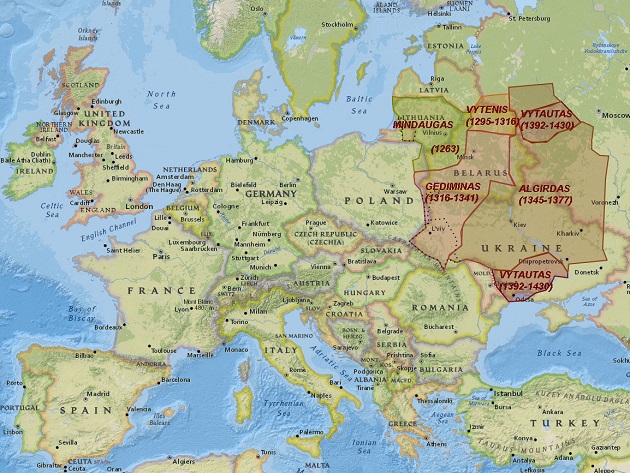
Establishment an expansion of the Grand Duchy of Lithuania in the 13th-14th centuries, superimposed on modern European state boundaries. ©Augustinas Žemaitis.
WHY THE MYTH? Lithuania has recently suffered a long period of occupations and foreign domination. It has regained independence most recently in 1990. This makes some foreigners believe that this was the first time Lithuania came into being as a separate country. However, this is far from the truth. There were two earlier periods Lithuania existed. The first one went on for centuries until 1795, when the Grand Duchy was conquered by the Russian Empire. Still, Lithuanians sought to restore the Grand Duchy and revolted multiple times. Eventually, Lithuanians restored a much smaller state. Even this Republic of Lithuania is, however, already 100 years old, as it was established in 1918 and continuously existed since then according to the international law, despite being occupied in 1940-1990 (see the above misconception "Lithuania was Russia" for explanation).
INSULTING? Depends on the exact claim. Some claims, e.g. claim that the Lithuanian nation was established in 1990, may seem somewhat insulting but, in general, this is not a major faux-pas unless coupled with "Lithuanians were Russians" or similar tenets (see above).
"Lithuanians are unwilling to regard minorities as Lithuanians"
THE TRUTH: Every citizen of Lithuania is regarded as a citizen of Lithuania by every other citizen of Lithuania, regardless of his/her origins or religious beliefs. There is simply no movement in Lithuania, popular or unpopular, that would seek to strip minorities of their citizenship.
However, the word "Lithuanian" in English essentially has two separate meanings. The first meaning is "A citizen of Lithuania" (nationality) and another is "Ethnic Lithuanian" (ethnicity). People of numerous ethnicities do live in Lithuania. Ethnic Lithuanians form a majority (~85%), but the ethnic minorities are also proud of their cultures. They neither consider themselves to be ethnic Lithuanians nor seek to be considered ethnic Lithuanians. In Lithuania, there is even an option to request the ethnicity to be written next to nationality on a Lithuanian passport, which people of the ethnic minorities often do (in total, more than half of Lithuania's citizens ask their ethnicity to be included in their passports). In the Lithuanian censae, people are also asked about their ethnicity (instead of their ancestry or race).
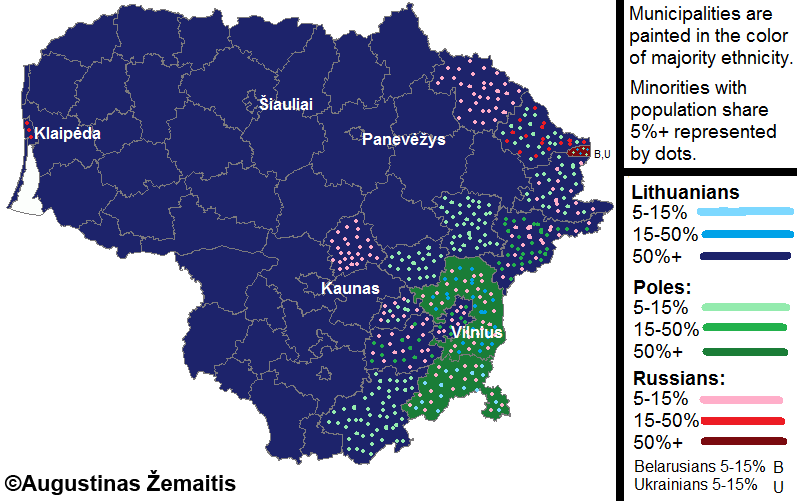
Ethnic map of Lithuania. The minorities are largely concentrated in the east. ©Augustinas Žemaitis.
While the word "Lithuanian" describes both the nationality and ethnicity in English, in Lithuanian language the situation is more complex. In the passports, the nationality is written as "Lietuvos", while ethnicity (if Lithuanian) as "Lietuvis" (in the regular speech today, however "Lietuvis" is also sometimes used for nationality due to the influence of the English language).
Labeling somebody who is not an ethnic Lithuanian to be an ethnic Lithuanian may be controversial both among the ethnic Lithuanians and the minority in question.
Historically, the ethnic Lithuanians are indigenous to Lithuania. Some of those who self-identify as Poles and Latvians possibly also are. The other communities have moved in from elsewhere during the 14th-21st centuries. Interethnic marriages were very uncommon before the 20th century and currently, an offspring often chooses one of the parent ethnicities.
WHY THE MYTH? In addition to the linguistic issues, ethnicity on itself is a concept difficult to understand to the Americans and Australians, because most do not have it, having descended from people of various immigrant ethnicities.
However, the notion of ethnicities is an extremely popular form of identification in Central/Eastern Europe, Asia and elsewhere where the populations are still mainly indigenous.
It is difficult to precisely define what ethnicity is, as it typically may include any number of such traits like native language, culture, religion, race, ancestry, self-identification and more. Which traits are included in the definition, depends on the particular ethnicity.
Even though mostly hereditary, ethnicity is not "race" as it is often invisible. Ethnicity is not "ancestry", as people of the same ethnicity may come from different countries. Ethnicity is not an "immigrant background", unless you'd count somebody whose forefathers arrived 200 or 400 years ago as having an immigrant background. While ethnicities may have their own "typical religions", one who converts out of them is not regarded to have lost its ethnicity (in this fashion, the majority of Lithuania's self-identifying ethnic Jews actually are non-Jews by faith, something baffling to the foreign Jews to whom being a Jew is mainly about religion).
By the way, in America and Australia, ethnic self-identification is popular in one particular group: the native indigenous populations. There, ethnicities are defined as "tribes" or "nations" (e.g. Cherokee, Navajo, Anangu). A non-Navajo who moves into Navajo territory is not to be considered a Navajo (nor, in most cases, he/she would seek to be recognized as a Navajo) - however, this does not mean that he/she would be unwelcome there. Likewise, referring to a non-Native-American as a Native American would be controversial.
Just like the Native Americans and Aboriginal Australians are proud of their indigenous heritage and many most still consider themselves part of the original Nation/Tribe despite of moving away from the "Homeland" (at the same time still being Americans or Australians), so does many European and Asian people, most of whom are indigenous to the continents, consider themselves to be part of their ethnic Nation as well as of their political nation.
INSULTING? Yes. Firstly, such claims are insulting because they make Lithuanians look unwelcoming when this is clearly not the case.
Secondly, claims that the Western divisions of society into groups (e.g. into nationalities, races, religions, and ancestries) are acceptable, whereas the divisions less popular in the West (e.g. into ethnicities) "should be abandoned everywhere", seem to convey the idea that the Lithuanian (and Central/Eastern European or Asian, in general) culture is somehow inferior to that of the West.
"Grand Duchy of Lithuania was not anyhow related to Lithuanians"
THE TRUTH: Grand Duchy of Lithuania was established by the ethnic Lithuanian (Baltic) leaders hailing from the Lithuanian ethnic lands. Later, however, the country expanded into Slavic and even Muslim lands. At its peak, the Grand Duchy of Lithuania did control lands well beyond ethnic Lithuania and, at the time, just 30% of its people were ethnic Lithuanians.
However, ethnic Lithuanian dynasties were still the ruling elite. While ethnic Lithuanians were pagan, so were the leaders and the entire Grand Duchy was considered pagan. After the leaders converted to Catholicism, so did the ethnic Lithuanians and so the entire Grand Duchy became considered to be Catholic. The plurality or majority of the Grand Duchy inhabitants may have been Orthodox Slavs both for some time before and after the official conversion of Lithuanians (and the Lithuanian leaders) - yet, the Grand Duchy was never considered Orthodox.
However, the Grand Duchy of Lithuania was not a nation-state in the modern sense. It did not seek to impose the Lithuanian language, religion, customs, or culture on its non-Lithuanian inhabitants. On the contrary, if the dukes would move from Lithuanian lands to rule the non-Lithuanian lands, they would commonly adopt the local language and religion. Even the written language of the Grand Duke's court was chosen by convenience: East Slavic and Latin languages were initially used, to be replaced by Polish later as the importance of Poland has increased.
WHY THE MYTH? The myth of a non-Lithuanian Grand Duchy of Lithuania rests precisely on the fact that it was not a nation-state, making it easy for the historians of other countries to emphasize those traits of the Grand Duchy of Lithuania that were more related to their ethnicities than to the Lithuanian ethnicity, thus claiming the entire Grand Duchy of Lithuania effectively was "their country".
Such claims are common in Belarus and Poland, mainly in the ethnicity-centered view on history that seeks to promote their ethnic history as more glorious and important.
For example, some Belarusians claim, that because an East Slavic language was used for writing by the Grand Duchy of Lithuania court, most of the Grand Duchy's nobility or even people in its main areas must have also spoken it natively. Moreover, as modern-day Belarus formed the bulk of Grand Duchy's East Slavic lands, that East Slavic language must have been Old Belarusian. On the top of these, such authors claim that ethnic Lithuanians must have inhabited a much smaller land at the time, likely just Samogitia, and were merely a minor group in the Belarusian-led-and-ruled Grand Duchy of Lithuania.
Such claims are, however, easily rebutted by the studies of placenames. In fact, Lithuanians did inhabit a somewhat larger area at the time than they do today, as parts of modern-day Belarus have Lithuanian-originated village names.
In fact, all the written-language-based claims about the Grand Duchy's demography are based on "exporting" the modern-day nation-state idea to a much-different Medieval era. Unlike today, in the Medieval era, it was very rare for the main spoken language to also be the written language. Most of Western Europe, for example, wrote in Latin but nobody spoke it natively. After all, only a few people could write at all at the time, and the leaders of the Grand Duchy themselves were illiterate. The written language used to be learned by the scribes together with the writing itself.
In conclusion, as Grand Duchy of Lithuania was not a "nation-state", it cannot be fully attributed to any single ethnicity in the way some later empires could have been, making this point moot.
INSULTING? These claims tend to be more funny than insulting to the general Lithuanian society as they don't expect the claims to be taken seriously. Typically, Polish claims tend to be disliked more as they are more widespread in the world than the Belarusian claims that are known little beyond Belarus.
"Lithuania was Polish"
THE TRUTH: Poland and Lithuania had a joint country between the years 1569 and 1795 (known as Poland-Lithuania, Polish-Lithuanian Commonwealth or the Republic of Both Nations). However, Poland and Lithuania were separate entities within that state in the same fashion as Austria and Hungary were in Austria-Hungary or England and Scotland are in Great Britain. No part of modern-day Lithuania was part of the Poland entity; the boundaries of the Lithuanian entity went far beyond the boundaries of modern-day Lithuania.
However, in the whole Poland-Lithuania Polish language became the lingua franca of the elite. Thus, as the centuries passed, the Lithuanian nobility and the people around capital Vilnius increasingly used Polish even when speaking among themselves. Peasants, on the other hand, remained Lithuanian-speaking and they formed the population majority. The situation seemed to be similar to that in Ireland, where the English language replaced Irish Gaelic (although in Ireland the linguistic shift eventually went much further).
That said, in Lithuania, there was much bilingualism and diglossia with many people, including the nobles, spoke both Polish and Lithuanian and switched the language depending on circumstances. At one time, it was shameful to be a Lithuanian speaker (Lithuanian was a "peasant tongue"), so they accentuated their acquired Polish cultural traits. Since the 19th century, it became somewhat fashionable to speak Lithuanian. Only in the 20th century did the Polish and Lithuanian nations finally separated completely and most of those who considered themselves both Poles and Lithuanians then adopting a single ethnicity with even siblings sometimes choosing different ethnicities.
So, Lithuania and Vilnius had many people who spoke Polish, however, most of these people were indigenous and of Lithuanian origins. There was little actual Polish immigration into Lithuania before the 20th century.
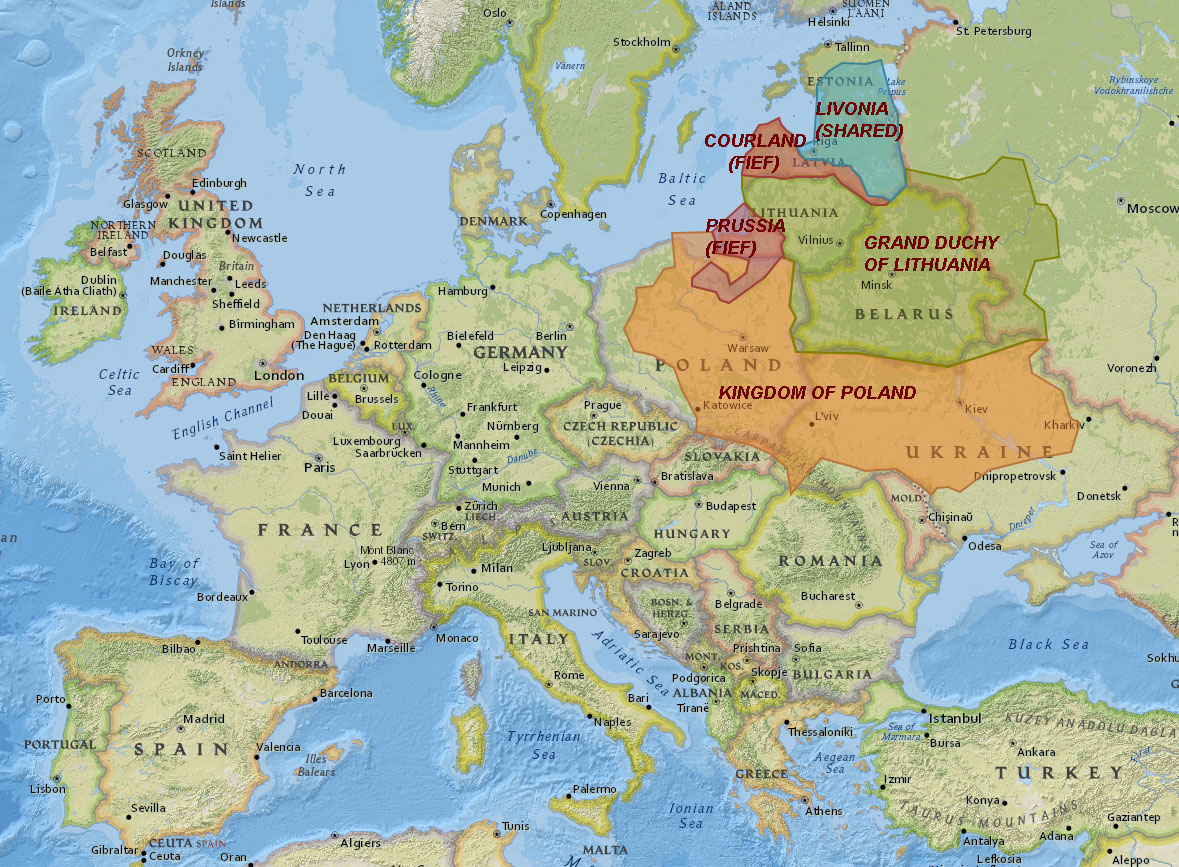
Polish-Lithuanian Commonwealth at its highest territorial extent (1616-1657) superimposed on modern European state boundaries. Poland and Lithuania entities are shown separately. ©Augustinas Žemaitis.
WHY THE MYTH? Outsiders often tend to oversimplify history. Instead of its full name (Poland-Lithuania or the Republic of Both Nations), outsiders often call the 1569-1795 joint Polish-Lithuanian state to have been just "Poland".
Furthermore, outsiders (and even many local researchers) have a difficult time understanding that the subtle-but-major difference that censae before the 1920s and 1940s asked just for the "native language" while censae after that asked for "ethnicity". They often lump both censae leading to false claims that in 1933 under one percent of Vilnius inhabitants were ethnic Lithuanians, for example (in reality, less than 1% said Lithuanian was their native tongue; however, they were allowed to choose just a single tongue and Polish was still the prestige language in Vilnius of the era).
INSULTING? It is insulting to some people, especially older ones who still have the collective memory of Polish-Lithuanian conflict over Vilnius region (1920-1940). However, as the Polish and Lithuanian relations are now much better and the historic conflict fades away, it is usually not seen as insulting as the claims that Lithuania was Russian. The Polish-language-domination era that was once thought by Lithuanians to have been a real dark age for their nation is now also being rediscovered in a more neutral light. Still, that doesn't make the claims that Lithuanians were Polish any more real.
Ethnic relations in Lithuania
History of Lithuania is often presented in very different lights depending on whoever writes it. There are numerous "positions" on various issues, quite often correlating with the ethnicity, religion and/or nationality of the author.
The reason for this is that for different groups of Lithuania's people each period tend to bring extremely different prospects. At the same time some groups prevailed, others were persecuted or even murdered en masse (and vice-versa). Naturally (often perhaps subconsciously), a person from a particular group, even if he is a historian, tends to put more emphasis on his or her own group, consider their losses to be more tragic, their own mistakes to be less grave, and their own victories to be more glorious.
This article aims to present all the standpoints on the history of Lithuania and the reasons why they exist by explaining the ethnic relations in Lithuania in every period of its turbulent history. The article is grouped by periods, and then by pairs of ethnicities.
First, however, we present a rough scheme of Lithuanian history which shows what was the situation for each group during each historical period, ranging from 1 (which means genocide) to 9 (which means domination beyond the borders of modern-day Lithuania). This diagram is capable of explaining differing opinions on various eras.
Of course, this diagram is a simplification: the reality was more complex, with each group subdivided into many sub-groups which also often faced different issues.

Diagram of the position of the ethnicities in Lithuania in different years. 1 - genocide, 2 - heavy persecution, 3 - medium persecution, 4 - low status (but little ethnic persecution), 5 - mediocre status, 6 - high status (but no cultural domination), 7 - threatened domination in Lithuania, 8 - undisputed domination in Lithuania, 9 - domination beyond the area of modern-day Lithuania. ©Augustinas Žemaitis.
Grand Duchy of Lithuania (1253-1569)
Grand Duchy of Lithuania largely peacefully expanded southwards and eastwards to become the largest country in Medieval Europe, ruling Ukrainians and Belarusians. However, being pagan, Lithuanians were also outcasts of Europe, having German crusades launched against them. Wishing to end such a situation and "modernize", Lithuanians sought to cooperate with nations such as Poles and Germans, adopting some of their cultural and economic practices and/or allowing their immigration.
Lithuanian-Belarusian/Ukrainian relations (1253-1569). Lithuanians expanded their country into Belarusian and Ukrainian lands by peaceful means, such as marriages. There was no animosity between these groups. While it was understood that the leaders of Lithuania are Lithuanians - i.e. the Pagan, later Catholic nation - Belarusians/Ukrainians also had a fair share of influence as well. Lithuanians who were sent to rule Slavic lands would learn to speak Belarusian/Ukrainian and often adopt the Orthodox faith. Moreover, as Lithuanians had no written language prior to their annexations of Belarus and Ukraine, they have adopted a Slavic language (together with Latin) for literary purposes. Ordinary people were not expected to adapt their faiths anytime.

Expansion of the Grand Duchy of Lithuania into the Belarusian/Ukrainian areas, superimposed on modern European state boundaries. ©Augustinas Žemaitis.
Lithuanian-German relations (1253-1569). Medieval Germans were a large restless nation that has expanded eastwards. One major goal was to spread Christianity: Germans have established military orders aimed at conquering then-pagan Lithuania, and these centuries of Lithuanian-German battles are still well remembered in Lithuania (as a result, Germans conquered Western Lithuania that later became known as Lithuania Minor). However, much of the German "expansion" was peaceful, as German traders and craftsmen migrated into Lithuanian-ruled cities. Tolerant and mostly rural Lithuanians sought to (l)earn as much as possible from the well-established German urban culture. Thus German city laws were copied by Lithuanian cities, while German traders were allowed to operate Christian churches in Vilnius and Kaunas even while Lithuania was still pagan.

Battle of Žalgiris (Grunewald), 1410. Lithuanians and Poles have decisively defeated the German knights. From then on, the Lithuanian-German boundary stood firm for hundreds of years. On its western side (Lithuania Minor) the German overlords had many Lithuanian peasant subjects. On its eastern side, Lithuanian overlords had some German merchant subjects.
Lithuanian-Polish relations (1253-1569). Lithuanians and Poles were neighboring nations sharing some enemies, leading to much cooperation. Eventually (1386), Lithuanian grand duke Jogaila (Polish: Jagiello) was crowned as a king of Poland, establishing a joint dynasty and even more contact. While Poland was smaller in size, it was more Western in culture. Wishing to integrate into the "framework of Europe" and end the devastating wars against German orders, Lithuanians chose to adopt Western practices such as Christianity, administration, and heraldry. These practices generally came to Lithuania in their Polish variants, leading the formerly pagan Lithuanian high society to become outwardly somewhat similar to their peers from Poland.
Lithuanian-Jewish relations (1253-1569). After grand duke Gediminas invited western craftsmen and merchants to Lithuania, the first Jews arrived. Afterward, Lithuanian rulers granted numerous privileges for Jews, giving them a special status that made them "free people" rather than the property of local nobles (as most non-noble Lithuanians were at the time). In general, Lithuanian leaders saw Jews as useful for the economy, while Lithuanian peasants intermingled little with Jews.

One of the letters of Gediminas that invited foreign craftsmen into Lithuania. ©Augustinas Žemaitis.
Lithuanian-Turkic relations (1253-1569). By the 15th century Lithuanians have conquered Turkic lands (modern-day southern Ukraine). Grand Duke Vytautas the Great brought local populations of Tatars and Karaims from there to Lithuania. Typically, they lived in separate districts and towns. Each minority at the time had its own role; while Karaims were town dwellers like Jews, Tatars were generally expected to serve in the military like the Lithuanian nobility. Both groups were allowed to continue professing their faiths, erecting kenessas, and mosques.

A wooden Tatar mosque in Raižiai, one of the traditionally Tatar villages. While this particular mosque has been constructed in 19th century, the unique Lithuanian Tatar style has been likely continuously used since the times Tatars arrived. ©Augustinas Žemaitis.
Polish-Lithuanian Commonwealth era (1569-1795)
After Polish-Lithuanian Commonwealth was formed in 1569, the nobility of both nations slowly integrated into one, mostly through Lithuanian nobles adopting Polish customs. Polish and Lithuanian nobilities were increasingly seen as a single nation, which also included the Belarusians. In addition to them, there were numerous "exotic" minorities, such as Jews, which were seen as foreigners, but nevertheless usually enjoyed great tolerance and protection
Lithuanian-Polish relations (1569-1795). Lithuania was a lesser partner in Polish-Lithuanian Commonwealth and the Polish nobility had the most important say on most issues. As such, throughout the era Polish culture and language were seen as more prestigious by the Lithuanian elite, causing it to adopt the Polish way of life over generations. Polish thus became the primary language of manors and Vilnius city. Many of these "Polonized Lithuanians" would see themselves as being both Poles and Lithuanians. Still, the overwhelming majority of Lithuanians remained non-Polonized but they were landless peasants, having little rights and say over issues.

The representatives of the nobility from every voivodship of Poland-Lithuania with their local clothes and emblems. Polish (left) and Lithuanian (right) flags crown the central tent. Anonymous painting of 18th century. Note the lack of differences between Lithuanian and Polish nobility, seeing itself as a single nation.
Lithuanian-German relations (1569-1795) in Lithuania Minor largely mimicked the Lithuanian-Polish relations in Polish-Lithuanian Commonwealth as Lithuanians adopted the German language and culture over generations. However, while nearly all local Lithuanians converted to the German Lutheran Church, they did not abandon their language, with the world's first Lithuanian language books printed in areas under German sovereignty. In Lithuania-proper the German minority, now Lutheran as well, was rather isolated from the society-as-a-whole and kept low-key, participating in their own businesses and urban affairs but not the national politics that were reserved for nobility.

Catechism of Martynas Mažvydas was the first printed book in Lithuanian, printed in the German-ruled part of Lithuania (1547). Throughout the Polish-Lithuanian Commonwealth period, more Lithuanian books were printed in German-ruled Lithuania minor than in the Polish-Lithuanian Commonwealth itself, where the Polish language predominated as the literary language.
Lithuanian-Russian relations (1569-1795). As the power of Muscovy was rising in the 16th-18th centuries, it gradually became the main menace of Lithuania. Officially viewing much of Lithuania as "historically Russian", it would often invade and sack Lithuanian villages and towns, detaching more and more Lithuanian lands. However, in the 17th century, a schism within the Russian Orthodox church made some Russians a target of persecutions in Russia itself. Lithuania offered refuge to them. Establishing many far-away villages they started Lithuania's Russian Old Believer community.

Old believer churches, the centerpoint of the Russian Old Believer refugee villages they have established in the 17th-18th centuries. ©Augustinas Žemaitis.
Polish-Belarusian/Ukrainian relations (1569-1795). Like Lithuanian culture, the Belarusian/Ukrainian culture was now secondary to Polish. The government attempted to bring Belarusians and Ukrainians closer to Poles by imposing an Eastern Catholic church on them, which would still follow Russian Orthodox rites but recognize Papal authority.

Josaphat Kuntsevych, inspired by Polish policies, encourages his fellow Belarusians to join the Eastern Catholic church. Later he was killed for his ideas, but the Eastern Catholic church took hold.
Lithuanian-Belarusian/Ukrainian relations (1569-1795) grew increasingly less relevant. Firstly, Lithuania ceded entire Ukraine to Poland in 1569, essentially losing its Ukrainian population. The remainder of Grand Duchy was culturally divided between Lithuanian-speakers and Belarusian-speakers, however, increasingly both groups were reduced to peasants who had little contact outside their immediate area (as the nobility and elite of both groups became Polish-speaking and effectively became a separate "noble nation").
Russian-Belarusian/Ukrainian relations (1569-1795). Russians have officially regarded Belarusians and especially Ukrainians of the Grand Duchy of Lithuania as natural allies and the proof that these lands are Russian. While some of them (especially Ukrainians) did indeed cooperate with Russians, this would typically not bring them the desired results of freedom.
Lithuanian/Polish-Jewish relations (1569-1795). Polish-Lithuanian nobility, seeing mostly craftsmen and merchant Jewry as useful to the economy, further extended the special rights of Jews that were above those of most Lithuanians, and accepted Jewish refugees from the lands where they were persecuted. Jews were regarded as a separate nation by Poles and Lithuanians and granted self-rule, a kind of state-within-a-state. Polish-Lithuanian Christian churches, however, sought to convert the Jews, mostly unsuccessfully.
Lithuanian/Polish-Gypsy relations (1569-1795). Unlike in various Western European countries, Gypsies were allowed to freely roam in Lithuania. Polish-Lithuanian nobility allowed them to spend time in their lands, sometimes performing various arts. Some Polish-Lithuanian nobles were appointed as "Gypsy kings" and had to ensure that the Gypsies pay taxes and abide by the laws.
Lithuanian/Polish-Westerner* relations (1569-1795). It became popular to hire artists from Western Europe (especially Italy) to design and decorate buildings and churches of the Polish-Lithuanian nobility, while some Westerner merchants arrived for trade. While there were numerous such residents in Lithuania over the Rennaisance and Baroque centuries, they were usually either just temporary residents, whereas those few who remained longer assimilated into the Polish-Lithuanian culture. As such, while Westerners left a significant legacy in the form of key buildings and arts of the Polish-Lithuanian Commonwealth, there was never a true Italian, French, or English community in pre-modern Lithuania.

Italian-designed sculpture-filled interior of Ss. Peter and Paul church in Vilnius, still among the most famous sights of Lithuania. ©Augustinas Žemaitis.
Russian Imperial era (1795-1918)
To many people of Lithuania, the 1795 Russian Imperial rule started as a mere change of the regime. However, by the mid-19th century, it turned into a major Russification drive, where non-Russian ethnicities were expected to assimilate into the Russian nation. Based on their sizes and relationship with the ruling regime, the ethnic communities of Lithuania found themselves in different situations and developed separate goals under such pressure. Even the centuries-old Polish-Lithuanian unity withered. Ultimately, Lithuania and Poland became independent separate countries in 1918.
Polish-Russian relations (1795-1918). Right from the collapse of the Polish-Lithuanian Commonwealth, Poles resented the Russian rule, organizing two revolts (1831, 1862) that took place in Lithuanian lands as well. The revolts failed, however, and part of the Polish nobility of Lithuania was persecuted for supporting them. Poles were seen by Russians as one of the most dangerous minorities to the unity of the Russian Empire.
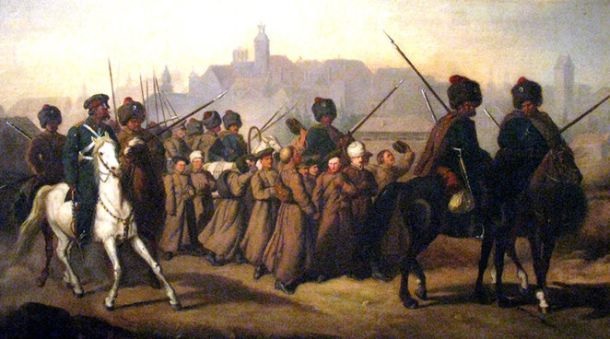
Polish-led mutineers against the Russian czar
Lithuanian-Russian relations (1795-1918). The massive Russian discrimination of Lithuanians began in the 1860s (after the second Polish uprising) when the Lithuanian language was outlawed from public use and print. Other policies included the deportation of some Lithuanians to Siberia, settlement of Lithuania by ethnic Russians, mass conversion of Catholic churches to Russian Orthodox use, dispossession of the Lithuanian nobility. These policies named "Restoration of the Russian beginnings" as Russians believed that "before becoming Polonized, Lithuania was ethnically Russian", denying the existence of the Lithuanian nation altogether and seeing Lithuania merely as a pawn in the Russian-Polish struggle for dominance. Lithuanians safeguarded their assaulted culture illegally by "bookcarriers" (who smuggled Lithuanian books from Lithuania Minor) and "daraktoriai" (secret teachers of the Lithuanian language). Such "cultural defense" eventually turned into a massive Lithuanian national revival. After discriminatory measures were finally curbed in 1904, Lithuanians increasingly demanded even more: autonomy and later independence.

As part of the 'restoration of the Russian beginnings', Russians have reconstructed the St. Nicholas Orthodox church from a local Baroque to a more-Russian-looking Neo-Byzanthine style.
Lithuanian-German relations (1795-1918) in the German-ruled part of Lithuania were rather good. However, the area was gradually slowly Germanizing as ethnic Germans moved into its towns while Lithuanians who moved into towns also often would switch to speaking German over generations. As such, the Lithuanian-speaking area of Prussia/Germany halved during the 19th century. That said, there was no state-sponsored persecution of Lithuanians. They were allowed to print Lithuanian language materials both for local use and to smuggle into Russian-ruled Lithuania where they were banned.

'1890s Lithuanian newspapers printed in German-ruled Lithuania minor. The left one is for local use, using more German loanwords and a German fraktur typeset, while the right one is meant for export into Lithuania-proper. This illustrates the mostly peaceful Germanization that went on in Lithuania Minor
Lithuanian-Polish relations (1795-1918). In the early 19th century, Lithuanian and Polish intellectuals shared an idea to recreate Polish-Lithuanian Commonwealth, fighting in two failed uprisings against Russia together (1831, 1862). As the century progressed however and serfdom was abolished, more and more Lithuanians began seeking to establish Lithuania independent of both Russia and Poland. While this included some nobles, the ideas became more widespread among non-nobles who were getting increasingly educated (after all, only 27,7% of nobles spoke Lithuanian in 1897, with 59,4% speaking Polish natively, whereas the peasants were primarily Lithuanian-speakers). Lithuanian-Polish relations thus largely coincided with class relations between landless peasants (Lithuanians) and landed nobility (Poles). It should be noted that "Lithuanian" and "Pole" were largely a cultural choice at the time as most local self-identified Poles would actually be of Lithuanian descent. Later, after it became usual to consider oneself just a Pole or a Lithuanian, there were cases where even siblings would "choose" different ethnicities.

An 1822 book by Adam Mickiewicz (Lithuanian: Adomas Mickevičius), a famous poet who wrote praises for Lithuania in the Polish language. In his days (1798-1855) the term Lithuanian included Polish native speakers of Lithuanian descent. Soon afterward, however, the goals of two nations divulged. ©Augustinas Žemaitis.
Russian-Jewish relations (1795-1918). Russians viewed the Jewish population of the Empire with distrust, but they also used Jews to dilute ethnic majorities in the Empire's Western lands, among them Lithuania. These became the only Imperial areas where Jews could freely settle, so-called "Pale of Settlement" and some towns thus even became Jewish majority. Jews were allowed to control the area's business (85%-95% of Lithuania's businessmen were Jewish in the era), leaving the political sphere to Russians. Even if the Jewish businessmen may have been well-off by Russian standards, Russia as a whole was poor on the global scale. So by the late 19th century, many Jews would opt to emigrate to the USA or Palestine, decreasing their population share in Lithuania.
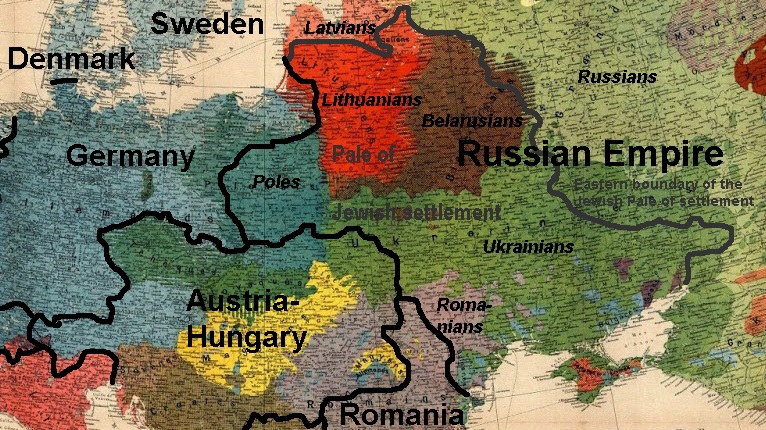
The map of the Jewish pale of settlement superimposed on the ethnic map of pre-WW1 Europe. As it is clearly visible, the eastern boundary of the Pale of Jewish settlement follows closely the eastern boundary of minority-majority regions of the Russian Empire. The Jewish pale of settlement nearly entirely corresponds to the area of the Russian Empire that was inhabited by Belarusians, Poles, Lithuanians, Ukrainians, and Romanians. The Jewish settlement allowed to make these areas more diverse (making any unified separatism more difficult), whereas Russia's heartland became more ethnically Russian
Lithuanian-Jewish relations (1795-1918). Lithuanians and Jews had very little contact as Lithuanians were nearly all peasants (working land) while Jews nearly all lived in towns (doing business), and neither group had political powers. The only time they would interact was when Lithuanian peasants would visit marketplaces and fairs. While nationalism was on the rise both among Lithuanians and Jews, these ideas did not clash as nationalist Jews (Zionists) generally saw Lithuanian independence as an irrelevant cause and instead wanted to create Israel in Palestine, where many emigrated. To Lithuanians, the Lithuanian independence meant regaining sovereignty from Russians and lands from Polish-speakers, with Jews not considered as enemies (the business sphere where Jews dominated was considered to be of secondary importance to most Lithuanians). Jews were also the most culturally different community an average Lithuanian of that pre-travel era would encounter, giving them a unique place in Lithuanian folklore.
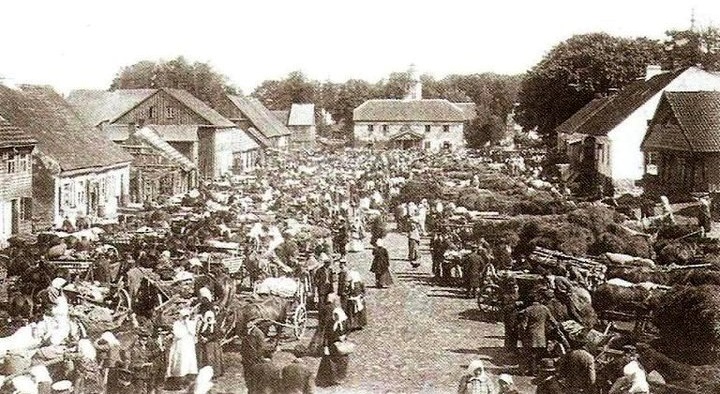
A market day in pre-war Gargždai. Town markets were one of the very few places where Lithuanians (buyers) and Jews (sellers) would have a reason to talk to each other and even there the conversations were limited to the sale.
Lithuanian-Gypsy relations (1795-1918). While there were few Gypsies in Lithuania, they had more contact with Lithuanians than other ethnic minorities. That's because most Lithuanians were peasants, and Gypsies generally traveled among the peasants, trading with them (and sometimes stealing from them). Gypsies thus became ingrained in the Lithuanian folklore nearly as much as Jews (a much larger community). In the 19th-century Lithuanian folklore, Gypsies are often romanticized, described as hot-tempered and good lovers (a stereotypical role filled by Italians, Spanish or French in the 21st-century imagination).
Russian-Gypsy relations (1795-1918). Russians sought to make Gypsies live a sedentary life. However, they failed. It is assumed many Gypsies have left Lithuania altogether, or simply evaded any censae.
Lithuanian-Westerner* relations (1795-1918). After Russia abolished the slavery-like serfdom many Lithuanians had previously endured (1861), Lithuanians became free to leave their "noble owners". Hundreds of thousands chose to leave their homeland altogether, especially for the USA. This was the first massive direct contact between Lithuanians and Westerners. Speaking little English, Lithuanian-Americans remained a separate community, establishing their own massive churches and other institutions. They also rallied foreign support for Lithuanian rights within the Russian Empire as well as Lithuanian independence. On the other hand, as Lithuania was just a province of the Russian Empire, almost no Westerners would come to live there at the time, making the Lithuanian emigrants (and their letters home) the only Lithuanian-Westerner link.

The first wave Lithuanian-Americans campaign for the liberty of Lithuania in the 1910s.
Interwar (1918-1940)
Lithuania became independent (1918) but Poland occupied Vilnius (1920). In the eyes of interwar Lithuanians, the Polish occupation of their capital was the main problem and injustice of interwar Europe. In hoping to regain Vilnius, they wanted to see Russians and Germans as allies - but as the time went on and totalitarianism entrenched in Russia and Germany, it became clear that these two nations have their own plans for Lithuania, and local Russian and German minorities also became suspicious.
Lithuanian-Polish relations (1918-1940) reached their nadir (the reminiscences of which are felt even today). After World War 1 (~1918) Polish leaders sought to restore the old Polish-dominated Polish-Lithuanian Commonwealth, but Lithuanians no longer wanted that. In a series of Polish-Lithuanian conflicts, Poland seized Eastern Lithuania (Vilnius region) in 1920, leading to a two-decade-long international conflict (1920-1939). During it, the Vilnius region was ruled by Poland, but claimed by Lithuania as its "treacherously hijacked heartland". In the Polish view, the Vilnius area was predominantly Polish-speaking and therefore Polish. In the Lithuanian view, Vilnius had been its traditional capital and the area always had a Lithuanian-majority population, even if the bulk of it started to speak Polish natively over the recent centuries; moreover, Poland recognized Vilnius as part of Lithuania before annexing it. During this period ethnic Lithuanians were treated with suspicion in Poland (including in the Vilnius region) and ethnic Poles were treated with suspicion in Lithuania. These minorities were seen as "fifth columns" that likely worked to either attach the Vilnius region to Lithuania or to attach entire Lithuania to Poland. Negative views of the other ethnicity were common in newspapers, caricatures, and even poetry of the era. Polish-Lithuanian bilingualism became less common on both sides of the border.

Every Lithuanian interwar celebration would have included symbolic gestures against Polish occupation of Vilnius. Slogans 'Hey Lithuanian, don't forget Vilnius' and 'We won't calm down without Vilnius' are visible here.
Lithuanian-German relations (1918-1940) slowly went from friendship to animosity as more and more Germans adopted Nazism. In the 1920s Lithuanians and Germans understood each other well as both felt treated unfairly after World War 1, losing significant lands where their ethnicity was in the majority. However, as time went by and Hitler came to power, German "unofficial claims" were expanded to Klaipėda Region (Memelland), an area with 41% Germans and 58% Lithuanians that was detached from Germany after World War 1 and recognized as an "autonomous part of Lithuania" after 1923 successful Lithuanian-led Klaipėda Revolt. By the 1930s Klaipėda region's ethnic Germans grew increasingly anti-Lithuanian, many joining Nazi organizations and some conducting terrorist activities. They generally felt forced to live under a "more primitive" Lithuanian culture - a situation they sought to end by joining their region to strengthening Germany. In reality, however, Lithuanian culture never gained supremacy in the Klaipėda region, where the entire local elite was German and most of the elected politicians pro-German as well. Lithuanian government merely offered a "Lithuanian alternative" to German education and media. Even its ability to enforce laws in Klaipėda grew increasingly limited as local Germans had the entire German Reich behind them. For instance, while Lithuania has conducted the first-in-Europe crackdown on Nazi organizations in 1935 (after the local Nazis had murdered a political opponent), the pressure by the German Reich forced Lithuania to pardon death sentences. In 1939, after Hitler's ultimatum, Germany annexed Klaipėda; Hitler was cheerfully welcomed by the local Germans while many Lithuanians left the Klaipėda region afterward, some forcibly. To make the matters more complex, in addition to the "obvious Germans" and "obvious Lithuanians", there were many "shades of grey" in the Klaipėda Region: those Lithuanians whose families were Germanized enough during the centuries of German rule to already consider themselves separate from the rest of Lithuanians. During the 1925 census, these people would identify themselves simply as "Klaipėdians" (rather than either "Lithuanians" or "Germans"); often, they would side with Germans on the cultural issues, complicating the Lithuanian cause in Klaipėda region further.
Weapons and symbolics confiscated from a German Nazi cell in Klaipėda after the 1935 Lithuanian crackdown on the local nazis
Lithuanian-Russian relations (1918-1940) initially seemed largely irrelevant. After defeating Russian reconquest attempts in 1918-1920, the Lithuanian government, pre-occupied with Poles, did not see the local Russians as a major threat. Moreover, most Russians departed after the Russian rule ended in Lithuania ~1915. Many of the remaining Russians (~2,5% of the total population) were Old Believers living in far-away villages. Urban Russians were too few to hope to stop the inevitable changes (e.g. the ascension of the majority Lithuanian language to the dominant status, conversion of many Russian Orthodox churches back to Catholic use). In the political sphere, the newly-Soviet Russia was initially too pre-occupied with Civil War and war against Poland to put any pressure on Lithuania, so it just played along. It even courted Lithuania to some extent, also attracting the support of some prominent Lithuanians who saw Russians as possible allies against Poles. With the rise of Stalin, the Russian government abandoned the "global communist revolution" approach and instead took a nationalist line whereby Poland and Lithuania were seen simply as "temporarily lost" Russian lands. Lithuanians grew increasingly wary of the Russian regime but couldn't do much about it. In 1939, a Soviet ultimatum forced Lithuania to allow Soviet military bases in, and these bases were then used to depose the free Lithuanian government.
Lithuanian-Jewish relations (1918-1940) were generally positive as independent Lithuania ended their state-sponsored discrimination (such as the limitations on their settlement and organizations). Jewish communities were given significant autonomy and a reserved seat at the government for their affairs. Jews generally recognized the new free Lithuanian government. However, even though more and more Lithuanians moved to cities and towns (some of which had effectively been a Jewish domain in the Russian Imperial era), there was still little contact between Lithuanians and Jews as they usually had different jobs and different faiths (therefore different holidays, pastimes, and almost no interethnic marriages). It seemed as if two different nations lived under the same urban sky. The share of Jews was declining due to popular emigration to South Africa and Palestine and lower birth rates. While more Lithuanians became businessmen, Jews still remained greatly overrepresented in that sphere. Suggestions for affirmative action to redress the Lithuanian underrepresentation in business were largely turned down by the "philosemitic" government of Antanas Smetona (1926-1940). In the 1930s, the popularity of communism and pro-Soviet thoughts among local Jews began to cause concern to Lithuanians.

Jewish bank in Kaunas. Established in 1920 (building constructed in 1925) it was one of many Jewish public and private institutions that sprung up in the interwar Lithuania.
German-Jewish relations (1918-1940). While elsewhere in Europe Germans grew increasingly negative towards Jews by the 1930s, in Lithuania this was still little visible until ~1937. That's because the cities with the most Germans (in the Klaipėda region) had very few Jews, and vice-versa. Moreover, the primary cause of Klaipėda's German Nazis was to "leave Lithuania and join Germany". On the other hand, having learned about the discrimination of their kin in Germany, Lithuania's Jews became tough on the local Germans. Many ethnic Germans were fired from Lithuania's Jewish businesses after 1934 (due to Jews being overrepresented among the business owners, a relatively big percentage of non-Klaipėda region Lithuania's Germans worked at Jewish businesses). After the pressure and clandestine actions of Nazi Germany made Lithuania slowly lose its grip over the Klaipėda region and its revert to Germany began to seem imminent, the local Nazis started to aim at the small Jewish population of Klaipėda city, with the German-dominated city council enacting discriminatory policies. By the time Nazi Germany occupied the Klaipėda region in 1939, all the local Jews fled the area to the rest of Lithuania or emigrated.
Lithuanian-Westerner* relations (1918-1940). After their World War 1 victory, the Western superpowers (France, United Kingdom, USA) dominated in the world. As such, Lithuanians worked hard to achieve their recognition and support. It was difficult, however, as Western powers generally sought to retain the post-WW1 "status quo" (which included Vilnius as a part of Poland). Such Western support for Poland has swayed 1920s Lithuanian opinions in favor of Germans and Soviets who sought to change that status quo. On a more personal scale, a few educated Westerners actually came to live in Lithuania, establishing businesses here or helping to develop its army. A lot more such "immigrants" were actually Lithuanian emigrants returning from the USA and investing their money in the homeland. Uneducated peasant Lithuanians, on the other hand, continued to flow to America in the 1920s but this trend has all but ceased in the 1930s as the Lithuanian economy improved and Western powers were hit by the global crisis. Older diaspora communities would help fund Lithuania which many still saw as their true homeland, while Lithuania itself funded the new-and-still-poor diaspora communities in Latin America (e.g. establishing Lithuanian schools there), seeing diaspora in the "safe far-away countries" to be essential for the survival of Lithuanians in the case of another foreign occupation.

The popularity of basketball in Lithuania is a result of the Lithuanian-Westerner relations of the interwar period. Basketball was 'brought in' from the USA by Lithuanian-Americans, who helped Lithuania to score its European champions title and bring the championship to Lithuania (in this image).
World War 2 (1940-1945)
During World War 2, Lithuania experienced alternating occupations and genocides (Soviet-Russian 1940-1941, Nazi German 1941-1944, Soviet-Russian after 1944). Each occupational regime had ethnic groups it supported and the ones it condemned to murders and persecutions. While many people of Lithuania would have preferred continuing freedom to any occupation, idealistic hopes for this were dashed. Instead, people often had to choose the "less evil" power of the two, and which one was "less evil" for you depended on which community you came from. This created a bitter divide between the ethnic communities that would linger on throughout the 20th century.
Lithuanian-Russian relations (1940-1945). Soviet occupation of Lithuania soon brought in heavy persecution of Lithuanians. Most of the perpetrators were Russians who formed the bulk of Soviet officials and occupational army (in Lithuanian language the "Soviet occupation" is thus often referred to as the "Russian occupation"). Lithuanians who had any associations with patriotic, devout religious or non-communist political beliefs arrested and killed. Even Boy Scouts, those who simply owned a Lithuanian flag or those who did not cast their vote at a single-candidate mock election was targetted. By 1941 June the persecution turned into genocide, as 2% of the entire population of Lithuania were expelled to Siberia in a single week, most to die there. In the same month, Lithuanian mutineers and German soldiers forced the Soviets out of Lithuania, but only after the Soviets had mass-murdered Lithuanian political prisoners in order for them not to be liberated. The Soviet occupation was replaced by Nazi German occupation. However, the fresh memories of Soviet terror were so potent that even at this time it was the possible return of the Soviets (rather than the Nazi German persecutions) that caused the greatest fear amongst Lithuanians. After Soviet return became inevitable (~1944) some 100000 Lithuanians decided to flee westwards instead of facing nearly certain death. Tens of thousands of others took up weapons, launching a guerilla war. Still, Russians restarted their genocide that was at the cruelest in Lithuania Minor, which was entirely Russified with both population and placenames replaced (now most of it is known as Kaliningrad Oblast). But hundreds of thousands of Lithuanians were also expelled from Lithuania-proper, even though the calls for all-out destruction of Lithuanians by a Russian minister for Lithuanian affairs Mikhail Suslov ("There will be Lithuania but without the Lithuanians") were not materialized. Some Lithuanians escaped persecutions by collaborating with the Russians, which often included giving out or even killing their own relatives and neighbors. Others made it seem that they are pro-Soviet by keeping their real opinions in secret, often even from their own children. Lithuania's Russian minority, on the other hand, often genuinely collaborated with the new Soviet regime, as that regime was based on Russian culture and language which were both better understandable to them than the Lithuanian culture.
Lithuanians murdered by the Soviets in Rainiai massacre, one of many brutal mass murders of Lithuanians masterminded by Russians in World War 2 Lithuania. Out of the at least 73 bodies only 27 could be identified due to mutilations. Prior to death, the victims were tortured: their genitals severed and put into their mouths, eyes picked out, bones crushed, skin burned by hot water and acid, they suffered electrocution. The victims were recently arrested by the Soviets for such 'crimes' as participating in the Boy Scout movement or owning a Lithuanian flag.
Russian-Jewish relations (1940-1945). Communist and pro-Soviet thoughts became popular among Lithuanian Jewry in the 1930s. At different times ~1940 Soviet occupation of Lithuania, Jews made up from 30% to 80% of Lithuania's communist party ranks despite being merely 7% of the total population. As Lithuania was occupied by the Soviet Union in 1940, large numbers of Jews welcomed the occupational army and a disproportional number of Jews thus became collaborators with the Soviet occupational regime. Even to non-communist Jews, it often seemed as if it was better (safer) to conform to the Russian rule and culture, just as they had previously conformed to the Lithuanian rule. After all, both Lithuanian and Russian cultures were equally foreign to Jews. After the German occupation of Lithuania (1941) which heavily persecuted and murdered Jews, Russians also became seen as the power most likely to drive Nazi Germany out of Lithuania. This was another reason why many Jews joined Soviet partisans in the latter stages of World War 2.

Ethnic composition of the Soviet partisans operating in Rūdninkai forests, responsible for, among other crimes, the mass murder of a Polish-Lithuanian Kaniūkai village. Such ethnic composition, with Russians and Jews the two dominant ethnicities, was common in most of Lithuania's genuinely pro-Soviet institutions and organizations of the early 1940s. This particular table was made by historian Rimantas Zizas, translated by True Lithuania.
Lithuanian-German relations (1940-1945). As the situation under Soviet (Russian) rule became more and more tragic, Lithuanians developed hopes that Germans (the only other great power in Continental Europe) would liberate them, which partly came to the truth in 1941. Lithuanians even believed that Germans would allow them to restore independent Lithuania and attempted to form a government in 1941 as the Nazi German armies invaded. However, Germans stripped this government of any powers and the government disbanded itself not wishing to be used to legitimize German war crimes; all Lithuanian political parties were then banned. While the Soviet-style mass murders of ethnic Lithuanians ceased and most anti-Lithuanian discriminatory Soviet measures were canceled, a slow realization came that Germany was just another imperial Power, itself responsible for the deaths of some 20 thousand ethnic Lithuanians. Underground anti-Nazi cells started to spring up in Lithuanian cities. They mostly worked in non-violent ways, such as publishing anti-Nazi press and hiding Jews from the Holocaust. Lithuanians were reluctant to take arms against Germany because every loss of Germany would make the Soviet re-occupation of Lithuania more likely, which was what Lithuanians feared the most. As the re-occupation started to seem inevitable by ~1943-1944, Lithuanians were already planning their next struggle against the Soviet Union.

Bilingual 1942 Nazi German posters in Šiauliai declare: 'The liberated Lithuania continues the struggle against the Bolshevism' and 'We are thankful to Adolf Hitler, our liberator'. Both the Nazi German and Lithuanian flags are waving, even though the former outnumbers the later (however, during the Soviet occupation the Lithuanian flag has been outlawed altogether). Such German propaganda was typical to the era: it sought to remind the far greater horrors of Bolshevism (recently suffered by the Lithuanians) in order to present the German nation as liberators or helpers in a mutual fight.
German-Jewish relations (1940-1945). Nazi Germany sought to Germanize much of Eastern Europe. Among the local non-German ethnicities, Jews were considered to be among the worst. Thus, Germans started persecuting of Lithuanian Jews right after the 1941 occupation. The situation gradually worsened: at first, mainly the Jews who collaborated with the Soviet regime were targetted, but soon Jewish civilians would be also murdered in their hundreds in many towns, including children. Eventually, the remaining Jews were forced to live in designated ghettos. Later even these Jews were massacred locally or in German concentration camps elsewhere. The Jews who were able to hide or run away did so, often never to return. Some fought back in the forests amongst Soviet partisans. Some others prolonged their own lives by collaborating with Nazi Germany and helping them to murder other Jews or hide the previous murders. This Nazi German genocide (Holocaust or Shoah) became the most tragic event Lithuanian Jewry ever faced and the main reason why its numbers decreased by up to 88% between census years of 1923 and 1959.

Entrance to the Jewish ghetto of Vilnius, established by the German occupational regime. Jews who lived in the ghettos were generally not allowed to leave on themselves.
German-Gypsy relations (1940-1945). Germans have regarded Gypsies to be "less evolved human beings" due to their poorness and due to most of them not doing any organized work or education. As such, a decision was made to "Treat Gypsies like Jews", effectively condemning them. As Gypsies always lived a nomadic life, it is unclear how many of Lithuania's Gypsies were murdered by Nazi Germany, the estimates ranging from 100 to 1000.
Lithuanian-Jewish relations (1940-1945). The collaboration of some Jews with the Soviet regime (1940-1941) created some anti-Jewish sentiment among Lithuanians. Nazi Germany, seeking to enlist locals to their cause, exploited these sentiments by a massive propaganda campaign which both positioned Nazi Germany as the main/only fighter against the evil of communism and then equaled all Jews to communists. As this happened soon after a major Soviet crime against humanity when 2% of entire Lithuania's population were killed or expelled in a single week, some Lithuanians answered the calls for cooperation/revenge by collaborating with Nazi Germany (the collaborators would also be rewarded in status by the Germans, or at least be able to avoid persecutions). Despite the Nazi German propaganda, however, most Lithuanians understood that the whole Jewish community should not be blamed for the actions of the Jewish-Soviet collaborators. Therefore, it became popular to save Jews (using such means as hiding them at home). By the number of Israel-recognized "righteous-among-nations" people per capita (i.e. non-Jews who saved Jews), Lithuania ranks second in the world only to the Netherlands (and the first in Central/Eastern Europe).

A 'righteous-amog-nations' certificate issued by Yed Vashem museum in Jerusalem proves that Kazys Grinius, an interwar president of Lithuania, participated in saving Lithuania's Jews from the Holocaust
Lithuanian-Polish relations (1940-1945) . While Lithuanians and Poles both were victims of the same totalitarian regimes, the interwar animosity between them did not subside. The main question was, should Lithuania and Poland both be liberated after World War 2, which country would then have Vilnius region? Thus Lithuanian and Polish freedom fighters operated separately in the Vilnius region, effectively making the WW2 in Vilnius a complex fight of four parties, each of them an enemy of every other party: Soviet Union, Nazi Germany, Lithuanian partisans, and the Polish Armia Krajowa (with shifting short-term unofficial alliances). Lithuanians and Poles would blame each other for some war crimes and civilian murders. These war crimes, however, were not of the same scale as Soviet and Nazi German genocides.

Local Lithuanians greets the Lithuanian army as it has gained the control of Vilnius in the November of 1939 (to be followed by Polish protests next day). Less than a year later, however, Vilnius and entire Lithuania were occupied by the Soviet Union. This was the general trend that the Polish-Lithuanian conflict was overshadowed by World War 2, with both nations effectively reduced to pawns in that global conflict.
German-Russian relations (1940-1945). At the beginning of World War 2, the German and Russian governments cooperated in partitioning Eastern Europe (Ribbentrop-Molotov Pact). According to the final version of this partition, the Klaipėda region was taken by Germany (1939) whereas the rest of Lithuania was occupied by the Soviet Union (1940). Lithuanians were recognized by Germany as a "Soviet nation" and many ethnic Lithuanians were deported from the now-German Klaipėda region. On the other hand, Germans from the rest of Lithuania were moved to Germany. Ethnic Germans and Russians then had little contact, but actually, both nations sought to expand further at the expense of the other. The war began in 1941: Germans sought to expand their "living sphere" by Germanizing Slavic (including Russian) Eastern Europe, while the Soviets sought to expand their totalitarian communism. Soviets were successful. Their soldiers, having received much hateful anti-German propaganda throughout the years, would kill and rape German civilians on a massive scale, removing Germans from entire provinces. Few Germans remained in Soviet-occupied Lithuania and those who did were especially discriminated: they had to hide their ethnicity, language, and religion long after World War 2 in order to save themselves.

A column of German and Lithuanian refugees who attempted to flee the Klaipėda region was overran by Soviet tanks. Such wanton killings (as well as torture and rapes) of the despised Germans at the hands of conquering Russians were extremely common in the mid-to-late 1940s Europe, resulting in deaths of some 2 million German civilians and expulsion of some 16 million. In Lithuania, the local German community, which consisted of 4% of the population prior to World War 2, basically ceased to exist.
German-Polish relations (1940-1945). Throughout the German rule, Poles generally saw Germans as an imperialist enemy power that has partitioned their country together with the Soviet Union in 1939. However, many Poles regarded the prospect of Soviet occupation as an even worse one. Additionally, the Poles sought to ensure that, after World War 2 ends, the Vilnius region would be reintegrated into Poland rather than into Lithuania. All these goals meant that while Polish guerilla Armia Krajowa (ruled by the government-in-exile and staffed by local Poles) fought against Germans, it has also cooperated with them to some extent in their fights against both Soviet and Lithuanian partisans, that way seeking to ensure the "best possible" outcome for Poles after World War 2 ends.
Russian-Polish relations (1940-1945). Most Poles generally saw Soviet Union (Russia) as an imperialist power that has partitioned Poland together with Germany. As the Polish-inhabited areas of Lithuania fell under Soviet rule, the local Poles suffered the Soviet persecution first hand, many deported to Siberia or killed (25000 people of Vilnius in 1939, for example). Such experiences made Poles especially wary of Russians and even after Lithuania was occupied by Nazi Germany in 1941, the Polish and Russian (Soviet) partisans would not join forces; they even fought each other. Very few Poles fought alongside Russians, forming pro-communist Gwardia/Armia Ludowa (the influence of this organization was later exaggerated by communist historians during the Cold War). However, unable to outgun the Russians, the Polish Armia Krajowa sometimes cooperated with the Russians in Lithuania during the later stages of the World War 2, incorrectly believing that this would ensure Poles a better situation after the war ends in the then-inevitable Soviet victory (with Vilnius-within-Poland being a major goal).

Polish (Armia Krajowa) and Russian soldiers patrol in Vilnius streets together after the mainly Polish efforts routed the Nazi German troops away. However, the bliss was short-lived, as the next day Russians have arrested their Polish 'allies' and then either murdered them, expelled them to forced labor or made them switch their allegiances to Soviet army
Polish-Jewish relations (1940-1945). Like Lithuanians, many Poles were dismayed by the Jewish collaboration with the Soviet Union which has occupied the once-Polish-controlled Vilnius region. Such collaboration, which was also popular among some other minorities (e.g. Belarusians), further entrenched the opinion that only the citizens of titular ethnicity could be trusted.

Minority people (i.e. non-Polish and non-Lithuanian) eagerly accept propaganda disseminated by the Soviet soldiers in the Soviet-occupied Vilnius region. Such an image, and even more so the images of minorities collaborating in killing the locals, lingered well beyond World War 2, supporting the idea among Poles and Lithuanians that the minorities such as Jews, Russians, and Belarusians are necessarily 'fifth columns' even if they would be citizens.
Soviet occupation (1945-1990)
As World War 2 ended and the Lithuanian guerilla war received no serious help from the West it became clear that the Soviets were there to stay. They have established the dominance of the Russian language and culture as well as state atheism; many non-Russian traditions were loathed. This was supported first by outright Stalinist genocide, then by milder persecutions. Lithuanians proved to be impossible to lure to the Soviet side, however, and thus an attempt was made to court Lithuania's minorities instead, which were also increased in size through settlement campaign. Despite all this, pro-independence thoughts were not rooted out and Lithuanians seized the moment to restore freedom in 1990.
Lithuanian-Russian relations (1945-1990) were those of a dominant colonialist nation (Russians) and a dominated nation (Lithuanians). Russian language and culture were heavily promoted by the state; even the anthem of the Lithuanian Soviet Socialist Republic mentioned the "Great Russian nation" but not the "Lithuanian nation". Russian settlers were moved in at large numbers (increasing their population share from 2,5% to ~10%). Most of them did not learn the Lithuanian language but all Lithuanians had to learn Russian, making Russian the new lingua franca. At the same time, hundreds of thousands of Lithuanians were murdered or expelled from Lithuania by the Russian regime. All the Catholic monasteries were closed but the Russian Orthodox monastery permitted to remain open. Such a situation was despised by many Lithuanians who hoped to end this oppression through independence. After the failure of the 1940s-1950s guerilla war Lithuanians generally kept their opinions private (as voicing them aloud would have led to prison or psychiatric ward sentences) but still tacitly acted in the way they saw to best prevent the assimilation of Lithuanians into Russians (e.g. refused to speak Russian in shops or were extremely against their kids marrying a Russian). After a thaw of the 1980s, the pro-independence voices were said aloud again.
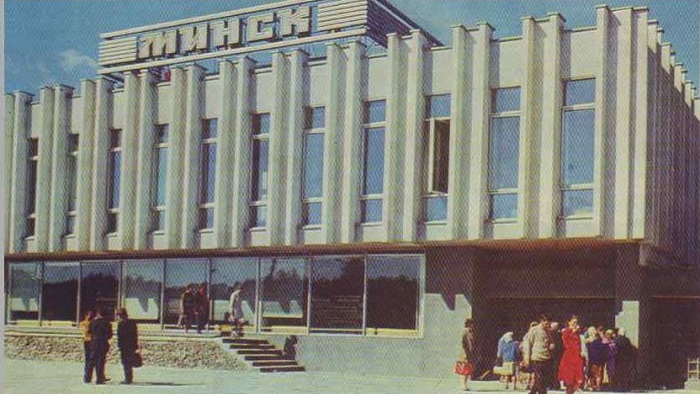
A postcard of a Soviet-built shop in the new district of Žirmūnai, Vilnius. These new districts typically had significant parts of their population Russians (moved in from Russia). The name of the shop is written in Russian here: during the occupation, the official names, inscriptions, and documents were either bilingual or Russian-only. Furthermore, the name itself is 'Minsk', a city in the Soviet Union outside Lithuania: many buildings, streets were (re)named during the occupation in non-Lithuanian-originated names and many monuments were erected for Russians (primarily communists)
Lithuanian-Polish relations (1945-1990). The Soviet occupational government effectively replaced much of Lithuania's Polish community by deporting local Poles to Poland and "importing" Poles from Belarus in their place. The "new Poles of Lithuania" no longer had the sense of being also Lithuanians that many of the "old Poles of Lithuania" had. This helped the Soviet regime to use "divide and conquer" stratagem to play Poles against Lithuanians on numerous occasions (see: Russian-Polish relations).
Russian-Polish relations (1945-1990). Russians sought to somewhat appease Poles to make them more content with the Soviet rule and possibly play them against Lithuanians. As such, Poles were given more rights than were common for non-autonomous Soviet minorities. For example, Poles had public schools with Polish as the medium of instruction. This helped to create (retain) more diversity in Lithuania, which in turn helped to promote the Soviet cause and Russian language as a "necessary lingua franca", as the Poles would be taught Russian but not Lithuanian (as a second language). Over the decades, Russians have hastened Russification policies and more and more Poles started to speak Russian even to their children (~20% of Lithuania's Poles spoke Russian natively by the 1990s). Lithuania's Poles did indeed become pro-Soviet, fearing that because of being unable to speak Lithuanian they would feel alienated in an independent Lithuania. Even in 1990 free elections, Polish-majority districts voted for the Soviet Communist party.

These charts show that in the late Soviet era (1989) some half of the Polish families were sending their children to Russian schools rather than Polish ones, something encouraged by the Soviet regime. ©Augustinas Žemaitis.
Russian-Jewish relations (1945-1990). Lithuania's Jewish community became Lithuania's ethnicity which would be Russified the most. Under the Soviet occupation, the majority of Lithuania's Jews would become atheists. By the 1970s their traditional Yiddish language gave way to Russian, which Jewish parents began to use to speak even to their own kids. While Russians would accept such "Sovietized Jews" amongst them, allowing them to rise to powerful positions, they would at the same time largely wipe out the "traditional" Jewish heritage of Lithuania. Many synagogues and Jewish religious cemeteries were destroyed in the 1950s-1970s. Jewish gravestones were often reused to build Soviet buildings. Soviets constructed many memorials to the victims of "fascist Germany", but none of them mentioned Jews explicitly, instead claiming that "Soviet citizens" were targetted. While most Jews at the time actually did become exemplary Soviet citizens (abandoning their own language, faith, and customs), they did not really want to live in the economically backward totalitarian Soviet Union. Some 50% have used the legal option to emigrate during 1959-1989, e.g. for "repatriation to Israel" (an emigration option that was not available to other ethnic communities and refused even to some Jews, to the dismay of Jewish diaspora). The Soviet Union also sought to play the increasingly influential Jewish diaspora against pro-freedom Lithuanians. The Soviet Union published propaganda works in English wherein many key anti-Soviet Lithuanians were accused of participating in the Holocaust. While such works had no historical basis (and the blamed Lithuanian-Americans were typically proved to be innocent by the OSI investigations), they were often accepted by the Jewish diaspora which was at the time passionately searching for the participants of the Nazi German genocide still at-large. At the same time, some of the people who truly murdered Jews during World War 2 were left untried in the Soviet Union itself, as long as they posed no threat to the Soviet regime.

Gravestones of a destroyed Vilnius Jewish cemetery, once used as a building material by Russians, have been molded into a memorial by the Lithuanians after 1990.
Lithuanian-Jewish relations (1945-1990). As the generations changed, Lithuanian-Jewish relations in Lithuania itself became both better and less relevant. With their numbers declining and culture assimilating, Jews were less and less regarded as power on themselves; instead, individual Jews were allying themselves with other powers. Some Jews still were genuinely pro-Russian/Soviet, a few did eventually become pro-Lithuanian but (possibly) the majority stayed out of these affairs conforming with whoever had the upper hand in politics (in 1945-1990, this meant the Soviet Union). A bigger Lithuanian-Jewish divide formed in Western countries. Both emigre communities there had very different collective memories of World War 2, as visible in their press and books of the time. Most Lithuanians would remember suffering at the hands of the Soviets, often aided by Jewish collaborators. Most Jews, on the other hand, would remember suffering at the hands of Nazi Germany, often aided by Lithuanian collaborators. Both the Lithuanian thought of "Liberation from the Soviets in 1941" and the Jewish thought of "Liberation from Nazi Germany in 1944" seemed radical and hateful to the other community (as what was "liberation" to one community meant genocide to the other). The ethnic Lithuanian and Litvak emigre communities remained separate as Litvak refugees integrated into wider Jewish communities while Lithuanians cooperated more closely with Latvian and Estonian diasporas with whom they shared their fate.
Russian-Russophone** relations (1945-1990). In addition to ethnic Russians, many people of other Soviet-ruled ethnicities were moved to live in Lithuania, primarily Ukrainians and Belarusians. After migration, these communities would often become Russophone (Russian-speaking) and assimilate into the Russian minority. That's because no schools, cultural institutions, TV or radio in these minority languages existed in Soviet Lithuania. Instead, these minorities were expected to use the wider-than-necessary network of Russian institutions. That meant they often abandoned their own languages and customs as useless.

One of the first buildings completed in WW2-ravaged Vilnius was the newly-established Russian-language theater (built by German POWs under Soviet orders). Its patrons were expected to (and did) include more than just Lithuania's Russian community. While ethnic Lithuanians would not frequent it that much as Lithuanian-language theaters were not closed down, for people from Lithuania's other minorities (Ukrainians, Belarusians, etc.) this was the only theater to go, as those minorities had no theaters of their own (and they were taught Russian language but not Lithuanian, so they could not have used the Lithuanian cultural institutions)
Russian-Gypsy relations (1945-1990). The rapid changes forced upon Lithuania by the Russian-dominated Soviet Union effectively destroyed the foundations on which the traditional Gypsy life was based. There was no more "Lithuanian village" with Lithuanian peasants who could trade with Gypsies or hire them for temporary works (instead, there were collective farms that had regular workers). Even their nomadic lifestyle itself was effectively banned, forcing many Gypsies to settle in the slum-like permanent "Taboras" near Vilnius. However, at the same time, the leftist Soviet regime provided Gypsies a previously-unavailable opportunity to live off government handouts, which many of them chose. While the Soviet government attempted to "integrate Gypsies" by "helping them" to live like the rest of the population, this generally failed. While the traditional Gypsy authorities slowly disintegrated, their lifestyle with large families, male dominance over the females, little education for children has remained. Lithuania's Gypsy community increased through Gypsy migration from the rest of the Soviet Union, however, unlike some other ethnic minorities, the Gypsies were not Russified, most of them speaking their own language and continuing their own culture.
Lithuanian-Russophone** relations (1945-1990). Lithuanians generally viewed other Soviet ethnicities in a more positive light than the Russians, seeing them as "sharing the plight of Lithuanians". That was especially true for the members of communities that also opposed russification, such as Latvians, Estonians, Western Ukrainians, and Georgians.
Lithuanian-Westerner* relations (1945-1990). While the Soviet Union put a massive effort into anti-Westerner propaganda (showing Westerners as morally corrupt and exploited by their own governments and peers), few Lithuanians actually bought any of it. Many would clandestinely listen to "Voice of America" and seek for rare banned literature and music imported from the West. Much of the knowledge Lithuanians had about the West came via diaspora relatives many had. Even though contacts with such relatives were closely watched by the Soviet secret services, Lithuanians generally understood that Western societies were much freer and richer than the Soviet ones. The Lithuanian diaspora itself put tremendous work in (re)establishing Lithuanian institutions abroad and lobbying the governments of their "new homelands" to help Lithuania. They were mostly successful in preventing the Western governments from recognizing the Soviet occupation of Lithuania but had no success in gaining military support for the Lithuanian struggle. Such lack of Western support (on top of words) for communist-occupied Eastern Europe became known as "Western betrayal". It likely tarnished the reputation of the West more than the Soviet propaganda did. To this date any discussion about a help NATO or EU would provide in case Russia attacks Lithuania would have many participants expecting another "Western betrayal".

Three Lithuanian partisans in 1950. They came back to Soviet-occupied Lithuania after a carefully-planned mission in the West to receive training. That was one of the very few times when Lithuanian pro-freedom activists have actually received actual help from the West. With just a few Lithuanian partisans so trained, it proved to be insignificant and Lukša-Daumantas was killed a year after this mission, with the partisan leadership itself destroyed within three years.
Independence era (post-1990)
As Lithuania became independent in 1990, Lithuanian culture flourished once again, while ethnic minorities were allowed full democratic participation. However, past discrimination suffered by Lithuanians made Lithuanians wary of these perils returning. On the other hand, some people from ethnicities that enjoyed a privileged past wished to see it returning, and such tensions, while low-scale, were used by foreign powers (especially Russia) to gain supporters among Lithuania's minorities. The need to "safeguard Lithuania from another Russian invasion" was among the reasons for swift integration into Western institutions such as NATO and the European Union. However, the EU integration also caused an unprecedented foreign influence over Lithuania (excluding the times of occupations) and massive levels of migration
Lithuanian-Polish relations (post-1990). As Poles make a majority in some Lithuanian municipalities they were able to establish a successful political party and demanded more rights to their language (such as using Polish placenames in minority-majority areas or writing their names in Polish letters). Lithuanians largely refused, seeing this as "dangerous" (the collective memory of Polonization still lingered). The tension created by these issues remained on the political level. On some questions, the common Polish views go in-line with those of patriotic/conservative Lithuanians (e.g. the importance of Catholic faith), while on others they are the exact opposite (e.g. language policy). The fact that Poland is now an ally of Lithuania (within NATO since 2004) generally helped to achieve a moderate reconciliation on historical issues.

Plaque with a Lithuanian street name and its Polish translation in ~92% Polish Medininkai village (Vilnius district municipality). These plaques, installed by the Polish-majority municipalities, are part of a long legal struggle that typically finds them illegal and contravening the official language laws. ©Augustinas Žemaitis.
Lithuanian-Russian relations (post-1990). After some initial tension ~1990 (when many Russians still sought to restore the Soviet Union) Lithuanians and local Russians found a peaceful modus vivendi by the late 1990s as Lithuanians increasingly stopped fearing a Russian invasion. Some third of Lithuania's Russians emigrated in the early 1990s (including most responsible for the Soviet Genocide). Still, some of those who remained also had anti-Lithuanian opinions and often chose not to learn the Lithuanian language. However, their children would usually speak Lithuanian and become more integrated. By the 2000s, anybody who would see the local Russian minority as dangerous would have been considered an alarmist. After the resurgence of Russian Imperialism under Putin and the 2014 invasion of Ukraine, however, the Lithuanian-Russian relations soured yet again. Increasingly many Russians shown outward pro-Imperialist signs (e.g. the George Strips), while a wary Lithuanian government banned some Russian TV stations for broadcasting anti-Lithuanian propaganda.
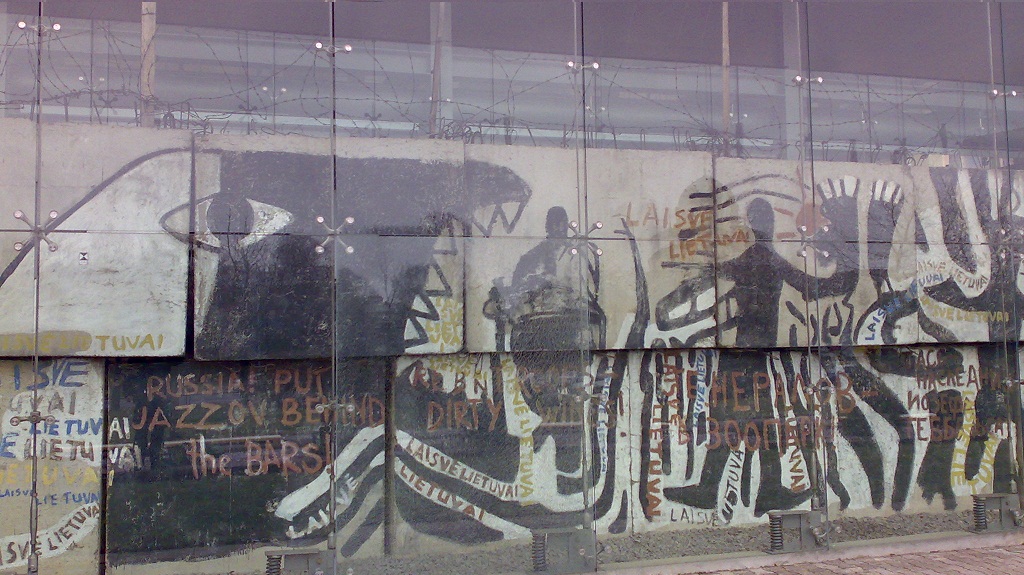
Grafitti on the barricades that were used to fend off the invading Soviet-Russian troops in 1991 January depicts Russia as a monster devouring the smaller nations. Such an image of Russian goals would sometimes take a backseat and sometimes resurge, but never fully dissipate. The events of 1991 January themselves cause a great rift between Lithuanians and Russians, as they are still recent enough for most Lithuanians to remember them well, while Russian media has created and disseminated conspiracy theories claiming that these events were a Lithuanian 'inside job'. ©Augustinas Žemaitis.
Polish-Russian relations (post-1990). After 1990 independence the Polish and Russian causes divulged as the communities were very different: Russians were mostly urban and less religious while Poles were mostly rural and very religious. In the 2010s, however, the expanding Polish party has been increasingly successful to also attract the Russian electorate. The gap between communities may have dwindled as more Russians became religious and more Poles adopted an urban lifestyle. Furthermore, local Poles still regard the Soviet Union somewhat less negatively than Lithuanians, making them seem to be natural allies for Russians in an era when fear of a new Russian occupation made Lithuanians distrust Russians once again.
Valdemar Tomaševski, the leader of the Polish minority rights party, is wearing a St. George's strip during the times of Ukraine war. This symbols came to symbolize Russian imperialism and such Tomaševski's actions were denounced by Poland's politicians who also widely support Ukraine against Russia. However, in Lithuania, local Russians and Poles seem to have more common ground than Poles of Poland have with the Russians from Russia. Image ©V. Balkūnas, source 'Lietuvos Rytas'.
Russian-Russophone** relations (post-1990). Even after independence the Russification of non-Russian Soviet minorities (Belarusians, Ukrainians) continued. Russian-Belarusian and Russian-Ukrainian marriages are extremely common, and the offspring usually considers himself/herself Russian and has Russian as the native language. However, as the Lithuanian economic situation improved, more people of ex-Soviet nationalities immigrated and these new migrants often shared more patriotic and even anti-Russian views (especially after Russia's 2000s-2010s invasions into Georgia and Ukraine).
Lithuanian-Russophone** relations (post-1990). After achieving their independence, Lithuanians tended to extend compassion and support to those ex-Soviet nations who also sought similar freedom, peace, and democracy, especially Chechens in the 1990s, Georgians ~2008, Ukrainians ~2014, and Belarusians. Such support would come from both the people and the state, often angering Russia. It included charity, memorials, official celebrations of these minorities' national days, accepting migrants and more. On the other hand, the more Russified / pro-Russian people of these ex-Soviet minorities are generally seen the same way as Russians are.

A monument for the president of de facto independent Chechnya Dzhokhar Dudayev in Vilnius. The freedom struggle he led against Russia inspired many Lithuanians, who could relate to the Chechens. The memorial is adorned by a poem of a famous Lithuanian poet Sigitas Geda: 'My son! If you will survive until the next century / And you'll once stop to look around from the heights of Caucasus / Remember that there too were men who had risen a nation / And went on to defend the sacred ideals of Freedom.' Parts of the poem invisible after the memorial was vandalized, likely by the local Russians. Image ©Augustinas Žemaitis.
Lithuanian-Jewish relations (post-1990). To most local Jews the most important change independence of Lithuania brought was the possibility to leave the economically ravaged Lithuania without having to face Soviet bureaucracy. 75% of Lithuania's remaining Jewry did so between 1989 and 2011, making the relative decline nearly similar to that of the 1923-1959 period (which included the Holocaust) and leaving just 3000 Jews in Lithuania. As such, the Lithuanian-Jewish relations increasingly became those between the now-free Lithuanians and diaspora Jews. The opening of borders allowed the free exchange of opinions for the first time since 1940, and the rift seemed big. Diaspora Jews understood and cared little about what Lithuanians have suffered during the Soviet occupation; they, however, cared much about Holocaust victims and knew that some perpetrators were still hiding in Lithuania. Lithuanians, on the other hand, knew surprisingly little about the Holocaust (as their forefathers have not suffered it while the Soviet view did not accentuate Jews as the key victims). On the other hand, Lithuanians suffered a lot under Soviet Genocide when victims would often be killed after false allegations. As such, Lithuania of the early 1990s attempted to rehabilitate all the victims of the Soviet regime, which would have also included the small percentage that was tried for real war crimes. After Jewish protests, such attempts were quashed. Lithuania then initiated court cases against WW2-era collaborators with the Nazi German occupational regime and, feeling a further pressure of diaspora Jews (mostly via the US and Israeli governments), paid over 100 million Litas to largely diaspora-ruled Jewish organizations in compensation for Soviet-nationalized Jewish properties (a remedy not available to any other ethnic community, even though all communities faced the Soviet nationalization and property destruction). While learning about the Jewish heritage of Lithuania became popular and many memorials were built for the Jewish tragedy, many Lithuanians also feel that this "coming to terms with history" is extremely one-sided: Israel has refused to either try or extradite Jews who participated in the Soviet Genocide of Lithuanians, while some diaspora Jews became instrumental in the Soviet Genocide denial. Seemingly few diaspora Jews try to understand Lithuanians in the same way as Lithuanians now try to understand Jews. This is likely because Western-based Jews often consider the situation in WW2 era Eastern Europe through the lens of the WW2-era Western Europe. The fact is, that throughout the Cold War (1940-1990) the World War 2 *in Western Europe* was well researched, and the situation there had been a relatively simple two-sided war between the genocidal totalitarian Nazi Germany and independent Western European countries (France, UK, the Netherlands, Belgium). World War 2 in Eastern Europe, including Lithuania, was a much more complex affair, however, with two genocidal totalitarian regimes (Nazi Germany and the Soviet Union) overrunning free countries; moreover, throughout the Cold War, there was no independent research into these areas, with many facts, numbers established arbitrarily by the Soviet propaganda. In the 1990s, the first post-WW2 local independent research discovered what the Soviets had manipulated and attempted to hide, and sought to share their knowledge with the West. For example, the Soviet murders that dwarfed the Holocaust in numbers (that had previously been known only from the personal accounts of the few survivors who fled to the West) became well-researched and much-talked-about among the Eastern European historians after 1990. To some Jews of the free Western World, however, such newly-available research was difficult to come in terms with, as in the Western European WW2 history it was any "new research" that typically came from biased sources, rather than vice-versa. Since the 2000s, wishing to keep a good relationship with Jews, Lithuanians are often directing their research away from potentially controversial issues, leaving the Holocaust underresearched (the "holes" in research are often replaced by empathic media-style declarations that are sometimes based on the old Soviet-era biased research or on guesses).

A sculpture to a Jewish doctor Tsemakh Shabad in Vilnius is just one among several thousand statues, memorial plaques and other symbols dedicated to Jews erected in post-1990s Lithuania that has filled the 'void of knowledge' about Jewish life that existed in Soviet Lithuania. ©Augustinas Žemaitis.
Nongypsy-Gypsy relations (post-1990). As Lithuania became independent, the Gypsy district (Taboras) of Vilnius became a major drug sale point which has also contravened other laws, e.g. avoiding paying for electricity. Lithuanian government attempts to curtail this by establishing a heavy police presence or relocating the Gypsies altogether generally failed until the 2010s. While the Romani people were few in number and would not have garnered wider attention, bigger problems in the Southeast Europe where Gypsies are more numerous led to various international initiatives to improve the conditions for the community.

Children playing at the Čigonų (Gypsy) street in Taboras of Vilnius. With high birth rates, unofficial teenage marriages, illegal economy and schacks in place of homes this remains a favela-like world apart from the non-Gypsy world. ©Augustinas Žemaitis.
Lithuanian-Westerner* relations (post-1990). After the 1990 independence, Lithuanians began to eagerly explore the Western culture and sought to imitate the more effective and democratic economic and political systems. Helped by a few early Westerner immigrants, various Western traditions also came into Lithuania, usually resulting in a unique fusion. After Lithuania joined the EU, Western influence became more direct and not always welcome. Some Westerners (such as Western European officials) looked down upon Lithuania, explaining certain cultural differences to mean that Lithuanians are "backward" and that they will eventually "come up with the West". This made some Lithuanians (including those who signed the Declaration of Independence) question the Western influence, claiming that such viewpoints remind those of colonialist nations. However, the majority continued to follow the "Westerner steps", replacing more and more cultural traits with the "superior" Western ones.

During the 2000s, English language has largely displaced the Lithuanian language from trademarks (even Lithuanian-owned). Only 5 out of 29 visible here on Panorama mall are Lithuanian-language, all of them created at 1995 or earlier. European Union regulations largely render Lithuania powerless in promoting its language for local commerce. ©Augustinas Žemaitis.
Lithuanian-African/Asian/Latin relations (post-1990). After 1990 the first Asians (excluding Russophones**) and, to a lesser extent, Africans and Latin Americans came to live in Lithuania. Lithuania was poor, so nearly all of them were either cultural migrants (fond of Lithuanian culture) or people who knew well in advance what to do in Lithuania (e.g. establishing ethnic cuisine restaurants or playing basketball professionally). As such, the Lithuanian views towards these early migrants were positive; some of them became TV or musical celebrities precisely because of their "exotic looks". There was no "political correctness" in the Western sense (whereby one is expected not to notice racial differences); the differences were noticed but treated with respect by the majority. As time passed and Lithuania grew richer, however, it became a minor destination for economic migrants who had fewer possibilities to prosper. Additionally, the reputation of Africans/Asians/Latin Americans was somewhat tarnished by Lithuanian emigrants to the West, who would report to their relatives back in Lithuania about the problems Western countries had with their non-European-originated populations. In this way, negative opinions on some groups (especially the Muslims) were imported from the West. European Union decisions to "share" illegal migrants are also expected to import the Western problem of the ethnic-religious conflict itself, unheard of in Lithuania for decades. The idea of Western-style "political correctness" and self-censorship is also currently promoted by some, mostly as a supposed benefit for these new migrants.

One of the many small groups of immigrants that capitalized on their 'exotic looks' were the Native Americans from Bolivia. Typically they would dress in their ethnic costumes and sell records of Native American music in streets, sometimes playing their folk music instruments themselves. Currently, the people in the major cities are already too used to various races and ethnic traditions for such 'marketing' to work. However, the Native American music salesmen may still get attention in small towns, such as during the Zarasai town festival of 2015 in this image. ©Augustinas Žemaitis.
Explanations
*Westerners (as used in this article) are people of the Western world, except for Germans. The group includes British, French, Spanish, Italian, American, Scandinavian, Dutch, and other Western ethnicities.
**Russophones (as used in this article) are ethnicities of the former Soviet Union (mainly Soviet settlers and their children), excluding Russians. Many of them speak Russian natively, most others speak better Russian than Lithuanian (hence the term). The two largest Russophone ethnicities are Belarusians and Ukrainians, smaller groups include people from Caucasus, Central Asia, Volga region, and Moldova.
Click [+] for more
Sister websites
- Destination Lithuanian America Lithuanian-American heritage sites map
- Global True Lithuania Lithuanian communities and heritage all over the world
- On Latvia All about Latvia
- True Lithuania Youtube English videos on Lithuania and interviews with Lithuanians abroad